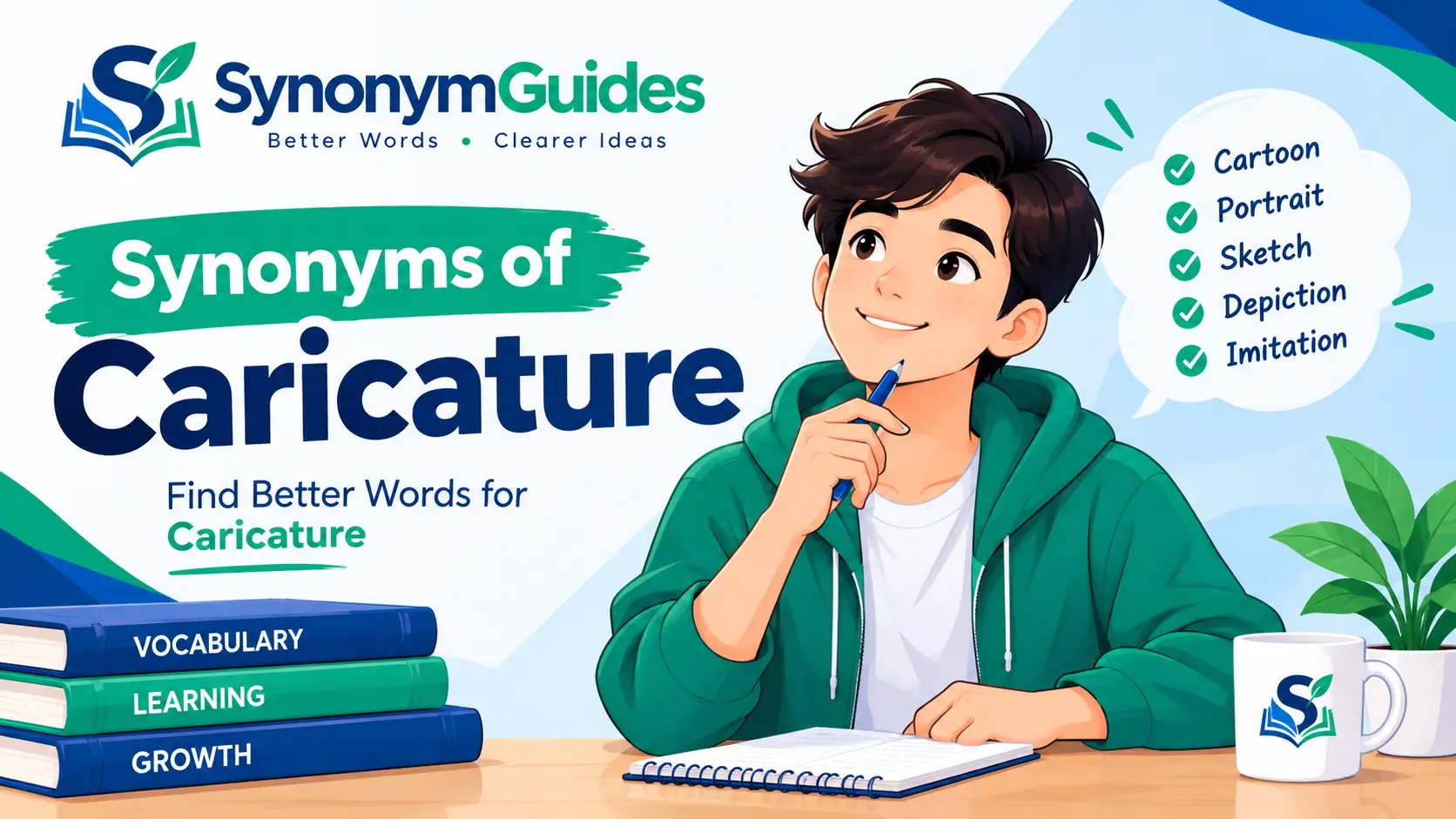
A synonym for “caricature” is parody, satire, exaggeration, burlesque, or lampoon. These words describe different ways of making a person, idea, or situation look unusual, funny, or foolish. The best choice depends on whether you mean a humorous drawing, an exaggerated description, or a form of criticism.
Key Takeaways
- Parody imitates a person, work, or style for humorous effect.
- Satire uses humor or irony to criticize people, behavior, or society.
- Exaggeration makes certain features or qualities seem greater than they are.
- Lampoon means to make someone or something look foolish through public criticism or humor.
- Mockery makes fun of someone or something, often in an unkind way.
- Choose a synonym based on whether you mean artwork, humor, criticism, or an unfair portrayal.
What Is Another Word for Caricature?
Another word for caricature is parody, satire, exaggeration, or lampoon. Each word describes a related way of presenting a person, idea, or situation in an unusual or humorous form.
A caricature often exaggerates a person’s physical features or personality traits to create a funny or recognizable image. For example, an artist might draw a politician with an unusually large head to emphasize a familiar feature. Similarly, a writer might describe a character as a caricature of a selfish businessperson.
However, the closest synonym changes with the context. A humorous imitation is usually a parody, while satire uses humor to expose problems or criticize behavior. Therefore, understanding the intended meaning helps you select the most accurate word.
Best Synonyms for Caricature and Their Meanings
The following words offer useful alternatives to “caricature” in art, literature, comedy, and everyday writing.
| Synonym | Meaning | Example |
| Parody | A humorous imitation of a person, work, or style | The show created a parody of popular detective dramas. |
| Satire | Humor used to criticize flaws or social problems | The novel uses satire to criticize political corruption. |
| Exaggeration | Making a feature or quality seem greater than it is | The cartoon’s exaggeration made the actor’s eyebrows look enormous. |
| Lampoon | A humorous attack that makes someone look foolish | The magazine published a lampoon of the mayor. |
| Mockery | An act of making fun of someone or something | His drawing turned the speech into mockery. |
| Burlesque | A comic imitation that exaggerates or makes fun of something | The performance was a burlesque of royal ceremonies. |
| Ridicule | Words or actions intended to make someone seem foolish | The cartoon exposed the policy to ridicule. |
| Distortion | A change that presents something inaccurately | The article offered a distortion of the original statement. |
| Imitation | A copy of someone’s appearance, behavior, or style | Her imitation of the teacher made the class laugh. |
| Depiction | A description or image of someone or something | The film’s depiction of the detective was almost a caricature. |
| Portrayal | The way a person or thing is represented | Critics called the character’s portrayal a caricature of rural life. |
| Send-up | A humorous imitation that makes fun of a subject | The sketch was a send-up of celebrity interviews. |
These synonyms overlap, but they are not always interchangeable. For instance, a caricature is often a specific exaggerated drawing or portrayal, whereas satire is a broader form of criticism. Meanwhile, a depiction can be serious and accurate rather than humorous.
Stronger and More Formal Synonyms for Caricature
When discussing art, literature, media, or social criticism, more precise words can help explain the type of caricature you mean.
1. Lampoon — A humorous attack on a person or institution. The columnist wrote a lampoon of the company’s new rules.
2. Parody — An imitation that creates humor by copying recognizable features. The comedy was a parody of classic adventure films.
3. Satire — Humor or irony used to expose flaws. The play uses satire to challenge unfair social customs.
4. Burlesque — An exaggerated comic imitation of a serious subject or style. The sketch presented a burlesque of formal political debates.
5. Travesty — A badly distorted or absurd version of something. The critic called the adaptation a travesty of the original story.
6. Pastiche — A work that imitates the style of another artist or work, sometimes humorously. The film is a pastiche of old detective movies.
7. Stereotype — An oversimplified idea about a person or group. The character relies on a stereotype rather than realistic details.
8. Misrepresentation — An inaccurate or misleading portrayal. The advertisement was criticized for its misrepresentation of the facts.
9. Grotesque portrayal — A representation that makes features seem strange, extreme, or disturbing. The artist created a grotesque portrayal of greed.
10. Comic distortion — An intentional change that creates humor through exaggeration. The portrait uses comic distortion to emphasize the subject’s expression.
For formal writing, “satire,” “parody,” and “misrepresentation” are especially useful. However, choose “travesty” when you want to stress that something has been turned into an absurd or deeply flawed version of the original.
Common and Everyday Synonyms for Caricature
In everyday English, simpler words and phrases can explain the idea without sounding overly formal.
– Funny imitation — A copy designed to make people laugh. His funny imitation of the coach entertained everyone.
– Exaggerated picture — An image that makes features look larger or more noticeable. The newspaper printed an exaggerated picture of the singer.
– Comic portrait — A humorous drawing of a person. The artist created a comic portrait of her friend.
– Impression — A performance that copies someone’s voice or behavior. His impression of the actor was surprisingly accurate.
– Spoof — A humorous imitation of a person, genre, or work. The video was a spoof of superhero movies.
– Send-up — A comic version that makes fun of a familiar subject. The sketch was a send-up of reality television.
– Funny portrayal — A humorous way of presenting someone or something. The play offered a funny portrayal of office life.
– Over-the-top depiction — A representation that pushes features or behavior to an extreme. The character was an over-the-top depiction of a strict manager.
These alternatives work well in casual conversations and accessible writing. For example, “comic portrait” fits a drawing, while “spoof” usually describes a humorous imitation of a larger work, style, or public subject.
Synonyms for Caricature in Art and Drawing
When “caricature” refers to visual art, the best alternatives describe the image, technique, or way the artist changes a subject’s features.
- Comic portrait — A portrait created for humorous effect.
- Exaggerated portrait — A portrait that emphasizes certain physical features.
- Satirical drawing — An image that uses humor to criticize a person or issue.
- Cartoon — A simplified or humorous drawing, sometimes exaggerated.
- Sketch — A quick or simple drawing; it is not necessarily humorous.
- Illustration — An image used to explain, decorate, or represent something.
- Distorted portrait — A portrait that changes a person’s features or proportions.
- Visual parody — An image that humorously imitates a recognizable style or subject.
For instance, a cartoonist might create a satirical drawing of a public figure to criticize a decision. In contrast, an ordinary sketch may simply show the person’s appearance without exaggeration or humor.
Synonyms for Caricature in Literature and Media
In books, films, journalism, and comedy, caricature often describes a character or portrayal that exaggerates particular traits.
- Stereotype — A simplified and often unfair representation of a type of person.
- Stock character — A familiar character type that appears in many stories.
- Parody — A humorous imitation of a work, genre, or style.
- Satire — A form of writing or performance that criticizes flaws.
- Spoof — A comic imitation of a familiar subject.
- Lampoon — A humorous attack on a person or institution.
- Comic portrayal — A humorous representation of someone or something.
- Exaggerated characterization — A character description that pushes certain traits to extremes.
Although these terms are related, they carry different meanings. A stock character is a familiar story type, while a caricature emphasizes traits so strongly that the portrayal may seem unrealistic. Likewise, satire can use caricature, but not every satirical work contains one.
Caricature Synonyms in Sentences
These examples show how related words work in natural sentences.
- Parody: The comedian performed a parody of a famous television host.
- Satire: The film uses satire to highlight problems in modern politics.
- Exaggeration: The artist used exaggeration to make the character’s nose stand out.
- Lampoon: The newspaper published a lampoon of the controversial proposal.
- Mockery: His comments turned a serious discussion into mockery.
- Burlesque: The stage show was a burlesque of traditional royal life.
- Distortion: The report presented a distortion of what the witness had said.
- Spoof: The short film was a spoof of action movies.
- Stereotype: The novel avoids portraying the farmer as a simple stereotype.
- Comic portrait: The illustrator created a comic portrait of the famous musician.
- Travesty: Reviewers described the remake as a travesty of the original.
- Pastiche: The director created a pastiche of classic mystery films.
Notice that some words describe humor, while others focus on accuracy or artistic style. Therefore, consider what the sentence is trying to communicate before replacing “caricature.”
Caricature vs. Its Closest Synonyms
| Word | Main Meaning | Best Used For | Tone |
| Caricature | An exaggerated portrayal of recognizable features | Art, characters, and descriptions | Humorous or critical |
| Parody | A humorous imitation | Films, books, performances, and styles | Playful or mocking |
| Satire | Humor used to criticize flaws | Politics, society, and behavior | Critical |
| Lampoon | A humorous attack that makes someone look foolish | Public figures and institutions | Sharp or mocking |
| Exaggeration | Making something seem greater than it is | Art, speech, and storytelling | Neutral or humorous |
| Stereotype | An oversimplified view of a person or group | Character writing and social discussion | Often negative |
| Travesty | An absurd or badly distorted version | Serious works, events, or procedures | Strongly negative |
| Spoof | A comic imitation | Entertainment and popular culture | Lighthearted or mocking |
The main difference is the purpose of the representation. A caricature exaggerates recognizable features, while a parody imitates a subject to create humor. Satire goes further by using humor to criticize behavior, beliefs, or institutions.
Similarly, “stereotype” focuses on an oversimplified idea about a group. “Travesty,” on the other hand, suggests that something has become an absurd or unacceptable version of what it should be.
Different Ways to Say “Caricature”
The following expressions help you discuss caricature in different situations.
Casual Expressions
Use these phrases in everyday conversation:
- Funny imitation
- Comic portrait
- Exaggerated picture
- Humorous drawing
- Over-the-top portrayal
- Funny version of someone
Example: “The artist drew a funny version of the school principal.”
Formal and Academic Expressions
These choices work well in essays, reviews, and critical writing:
- Satirical portrayal
- Exaggerated representation
- Comic depiction
- Distorted characterization
- Simplified representation
- Misleading portrayal
Example: “The novel presents an exaggerated representation of social ambition.”
Expressions for Comedy and Entertainment
When discussing films, performances, or humorous writing, consider these phrases:
- Parody of a character
- Spoof of a movie
- Satirical imitation
- Comic send-up
- Humorous impersonation
- Burlesque of a tradition
Example: “The show offers a comic send-up of celebrity culture.”
Expressions for Negative or Unfair Portrayals
When a representation is inaccurate or unfair, these alternatives may fit better:
- Distorted portrayal
- Unfair representation
- Oversimplified image
- Misleading depiction
- One-sided characterization
- Stereotypical portrayal
However, these expressions are not all synonyms for caricature in every context. Use them when you want to emphasize the unfairness or inaccuracy of the representation.
Related Words for Caricature
Understanding related word forms can help you write more clearly and avoid repeating the same term.
| Word | Part of Speech | Meaning | Example |
| Caricature | Noun or verb | An exaggerated portrayal; to portray through exaggeration | The artist caricatured the politician. |
| Caricaturist | Noun | An artist who creates caricatures | The caricaturist drew the guests at the event. |
| Caricatured | Verb form or adjective | Portrayed in an exaggerated way | The character was caricatured as greedy. |
| Caricaturing | Verb form | Creating an exaggerated portrayal | She enjoys caricaturing public figures. |
| Exaggerate | Verb | Make something seem greater or more extreme | The writer exaggerated the character’s fears. |
| Exaggerated | Adjective | Made to seem greater or more extreme | His exaggerated expression made us laugh. |
| Parody | Noun or verb | A humorous imitation | The sketch parodied a popular advertisement. |
| Satirical | Adjective | Using humor to criticize flaws | The writer produced a satirical article. |
| Satirize | Verb | Criticize through humor or irony | The play satirizes workplace politics. |
| Stereotypical | Adjective | Based on an oversimplified idea | The film uses a stereotypical villain. |
These related forms help you describe both the artwork and the process behind it. For example, “caricaturist” names the artist, while “caricatured” describes someone or something represented through exaggeration.
Antonyms of Caricature
Caricature has no single opposite in every context. However, the following terms describe approaches that avoid exaggeration or present a more balanced representation.
- Realistic portrayal — Represents a person or situation in a believable way.
- Accurate depiction — Presents details correctly.
- Faithful representation — Stays close to the original subject.
- True-to-life portrait — Shows someone in a natural, believable manner.
- Balanced portrayal — Presents different sides fairly.
- Objective description — Focuses on facts rather than personal judgment.
- Literal representation — Presents something directly rather than through exaggeration.
- Nuanced characterization — Shows a character’s complexity instead of reducing them to one trait.
For example, a caricature of a strict teacher might exaggerate every negative quality. A realistic portrayal would show the teacher’s strictness while also including other parts of their personality.
Frequently Asked Questions
What Is the Strongest Synonym for Caricature?
Lampoon is a strong choice when a caricature mocks a person or institution. Meanwhile, “travesty” is useful when you mean a badly distorted or absurd version of something. If the emphasis is on humorous imitation, “parody” may be more accurate. The best word depends on the intended effect.
What Is a Better Word for Caricature?
“Parody” may be better when discussing humorous imitations, while “satire” suits works that criticize social or political problems. For a drawing, “comic portrait” can be clearer. However, if you mean an unfair or inaccurate description, “distorted portrayal” may express your point more precisely.
What Is a Formal Synonym for Caricature?
Formal alternatives include satirical portrayal, exaggerated representation, distorted characterization, and comic depiction. In literary analysis, “caricature” itself is also an appropriate formal term. Choose “stereotype” only when the portrayal reduces a person or group to an oversimplified set of traits.
What Is Another Word for Caricature in Art?
In art, useful alternatives include “comic portrait,” “exaggerated portrait,” “satirical drawing,” and “distorted portrait.” However, “cartoon” and “sketch” are broader terms. They describe types of drawings that do not always contain the exaggeration or humor associated with a caricature.
What Is the Difference Between Caricature and Parody?
A caricature exaggerates recognizable features or traits to create a humorous or critical portrayal. A parody imitates a person, work, or style to create humor. For example, an exaggerated drawing of a singer is a caricature, while a comedy sketch imitating the singer’s music videos is a parody.
What Is the Difference Between Caricature and Satire?
Caricature is a type of exaggerated portrayal, often used in drawings or character descriptions. Satire is a broader way of criticizing flaws through humor, irony, or exaggeration. A political cartoon may use caricature to deliver satire, but satire can also appear in novels, films, and essays.
Is Caricature Always Negative?
No, caricature is not always negative. Artists often exaggerate features in a playful way to entertain people or celebrate a recognizable quality. However, caricatures can also ridicule people or reinforce unfair stereotypes. The tone depends on the artist’s purpose, the subject, and how the audience interprets the portrayal.
Final Thoughts
The best synonym for “caricature” depends on whether you are describing art, humor, literature, or criticism. “Parody” works well for humorous imitation, “satire” suits social criticism, and “lampoon” describes a mocking attack. Meanwhile, “exaggeration” focuses on making features or qualities seem more extreme.
For a drawing, consider “comic portrait” or “exaggerated portrait.” When discussing a fictional character, “distorted portrayal” or “stereotype” may fit, depending on the meaning.
Ultimately, choose a word that captures the purpose and tone of the original portrayal. A precise synonym makes your writing clearer and helps readers understand whether you mean humor, criticism, exaggeration, or unfair representation.