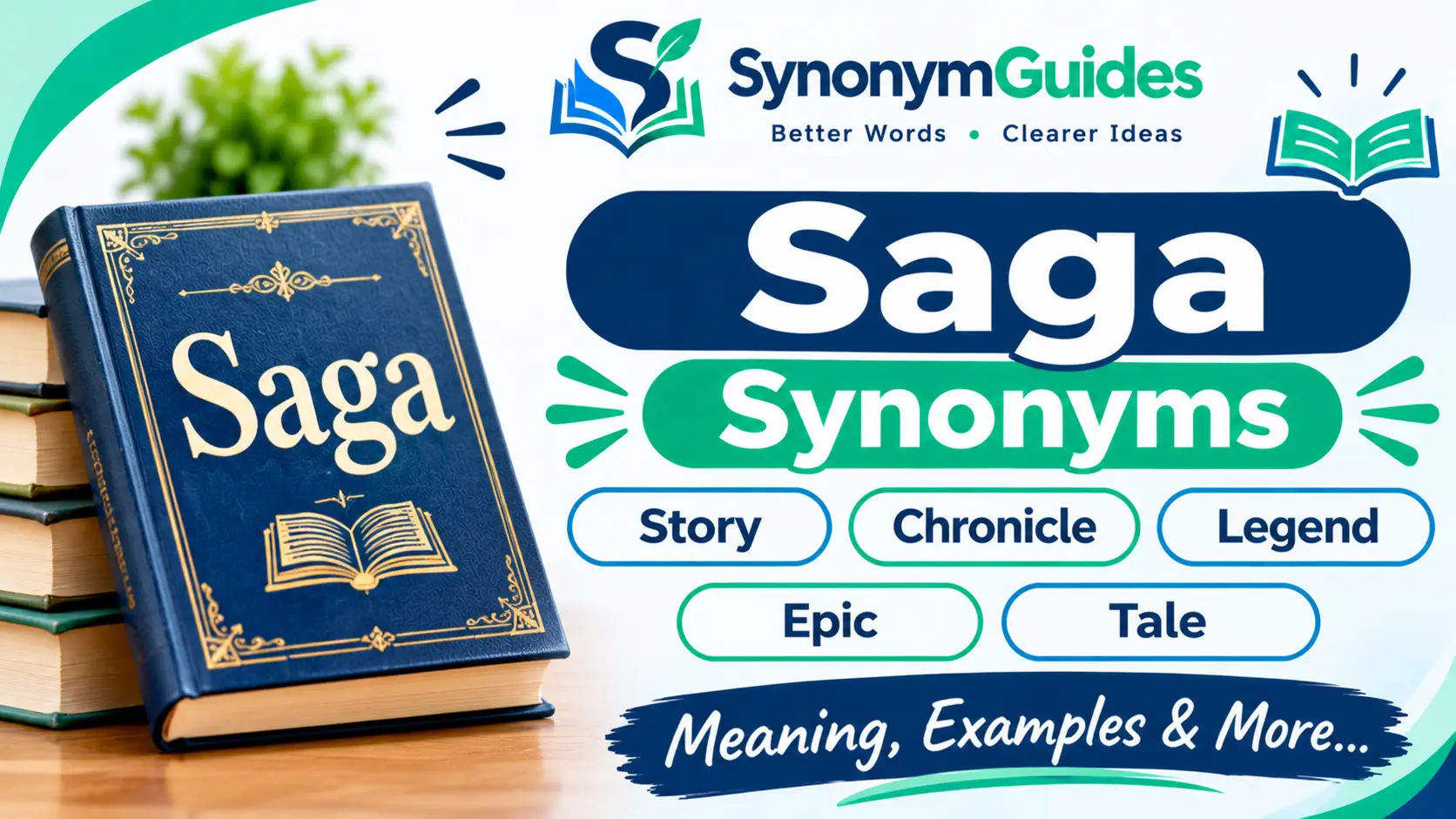
A saga can also be called an epic, tale, story, chronicle, adventure, odyssey, narrative, or journey. These words describe extended stories, dramatic experiences, or a series of connected events. However, they do not always mean exactly the same thing. Some emphasize a long and complicated experience, while others focus on storytelling, adventure, or historical events.
This guide explains the most useful alternatives to saga, their meanings, differences, and examples. As a result, you can choose the right word for your sentence and tone.
What Does Saga Mean?
A saga is a long, detailed story or a series of events involving important experiences, challenges, conflicts, or adventures. It can describe a fictional narrative, a historical account, or a complicated real-life situation that develops over time.
Example: The family’s immigration saga inspired several generations to pursue their dreams.
The word is commonly used in literature to describe epic stories about families, heroes, and historical events. In everyday English, it can also describe a lengthy or complicated situation, such as a workplace dispute or an ongoing legal problem.
A saga often suggests that something has taken considerable time and involved several developments. Depending on the context, it can sound dramatic, humorous, historical, or emotional.
Quick Answer: Synonyms of Saga
Here are 10 useful alternatives to saga and their meanings:
| Synonym | Meaning | Best Used For |
| Epic | A long story involving significant events | Heroic stories and achievements |
| Tale | A story about events or experiences | General storytelling |
| Story | An account of connected events | Everyday communication |
| Chronicle | A detailed record of events over time | Historical accounts |
| Narrative | A structured account of events | Writing and storytelling |
| Adventure | An exciting or unusual experience | Challenging experiences |
| Odyssey | A long journey involving difficulties | Personal journeys |
| Legend | A traditional or famous story | Folklore and heroic accounts |
| Journey | A process involving progress and experiences | Personal development |
| Drama | A situation involving conflict or tension | Complicated situations |
10 Best Synonyms of Saga With Examples
1. Epic
An epic is a long, impressive story involving heroic characters, significant events, or extraordinary achievements. Unlike a saga, which can describe ordinary real-life complications, an epic usually suggests something grand, memorable, or heroic.
Example:
- The novel tells an epic about a warrior fighting to protect his homeland.
- Their journey across the mountains became an epic adventure.
Tone: Literary, dramatic, and grand.
Saga vs. Epic: A saga emphasizes an extended sequence of events, while an epic emphasizes the scale and importance of those events.
2. Tale
A tale is a story about real or imaginary events, often shared to entertain, inform, or teach a lesson. It is a simpler alternative to saga and does not necessarily suggest a long or complicated experience.
Example:
- My grandfather told us a fascinating tale about his childhood.
- The book contains a beautiful tale of friendship and courage.
Tone: Traditional, literary, and conversational.
Saga vs. Tale: A saga usually involves an extended story, while a tale can be short and straightforward.
3. Story
A story is an account of connected events involving people, experiences, or situations. It is one of the most common alternatives to saga because it works in both everyday conversations and creative writing.
Example:
- She shared the story of how her family started its business.
- The entire story took several years to unfold.
Tone: Simple, neutral, and everyday.
Saga vs. Story: A saga suggests a lengthy or eventful story, whereas story is a general term for any account of events.
4. Chronicle
A chronicle is a detailed record of events arranged in the order they happened. It is especially useful when describing historical developments, family histories, or significant events over time.
Example:
- The historian wrote a chronicle of the city’s development.
- Her journal became a chronicle of the family’s difficult years.
Tone: Formal, historical, and informative.
Saga vs. Chronicle: A saga often emphasizes dramatic experiences, while a chronicle focuses on recording events and their sequence.
5. Narrative
A narrative is a connected account of events, either real or fictional. It is commonly used in academic writing, journalism, literature, and professional communication.
Example:
- The documentary presents a compelling narrative about environmental change.
- His personal narrative explains the challenges he faced while building a career.
Tone: Formal, academic, and professional.
Saga vs. Narrative: A saga suggests an extended and eventful experience, while a narrative describes the way events are presented.
6. Adventure
An adventure is an exciting, unusual, or sometimes risky experience involving challenges and discoveries. It is a useful alternative when a saga describes an exciting journey rather than a complicated situation.
Example:
- Their adventure through the rainforest changed their perspective on nature.
- What began as a simple trip became an unforgettable adventure.
Tone: Exciting, positive, and informal.
Saga vs. Adventure: A saga emphasizes a long sequence of events, while an adventure focuses on excitement, exploration, or risk.
7. Odyssey
An odyssey describes a long, challenging journey involving unexpected experiences and personal growth. It often has a poetic or literary quality and can describe both physical and emotional journeys.
Example:
- Her journey from a small village to international success was an incredible odyssey.
- Recovering from the setback became an emotional odyssey.
Tone: Literary, poetic, and expressive.
Saga vs. Odyssey: A saga can describe an extended story or complicated situation, while an odyssey specifically emphasizes a long and challenging journey.
8. Legend
A legend is a traditional or widely known story, often involving heroic people, extraordinary events, or historical figures. Unlike a saga, a legend may include fictional or exaggerated details passed down through generations.
Example:
- The legend of the brave king continues to inspire young readers.
- Local storytellers shared a legend about the mysterious mountain.
Tone: Traditional, historical, and imaginative.
Saga vs. Legend: A saga focuses on an extended sequence of events, while a legend emphasizes a memorable story that may become part of cultural tradition.
9. Journey
A journey refers to the process of traveling from one place to another or progressing through a series of personal experiences. It is particularly useful when a saga describes someone’s development, struggles, or achievements.
Example:
- Her educational journey involved determination and hard work.
- Building a successful company was a challenging journey.
Tone: Positive, reflective, and conversational.
Saga vs. Journey: A saga highlights the events and complications of an experience, while a journey emphasizes progress and development.
10. Drama
A drama is a situation involving conflict, tension, emotional reactions, or unexpected developments. It can replace saga in informal conversations when describing a complicated situation that continues for a long time.
Example:
- The disagreement between the two departments turned into unnecessary drama.
- Their ongoing family drama affected everyone’s daily routine.
Tone: Conversational, emotional, and sometimes humorous.
Saga vs. Drama: A saga suggests a lengthy series of events, while drama emphasizes conflict, tension, and emotional reactions.
Synonyms of Saga in Different Contexts
The best alternative depends on what you mean by saga. A literary story, personal struggle, and historical account may require different words.
1. Saga Meaning a Long or Epic Story
When describing a lengthy fictional story involving several characters and events, choose words that emphasize storytelling and scale.
Use:
- Epic
- Tale
- Narrative
- Legend
- Chronicle
Example: The author created a fascinating saga about a royal family and its struggles.
Alternative rewrites:
- The author created a fascinating epic about a royal family and its struggles.
- The author wrote an engaging tale about a royal family and its struggles.
2. Saga Meaning a Complicated Real-Life Situation
When describing an ongoing problem involving disagreements, delays, or repeated complications, everyday alternatives are often more natural.
Use:
- Ordeal
- Drama
- Affair
- Episode
- Complication
Example: The insurance saga continued for months before the company finally approved the claim.
Alternative rewrites:
- The insurance ordeal continued for months before the company finally approved the claim.
- The insurance dispute continued for months before the company finally approved the claim.
3. Saga Meaning a Long Personal Journey
When discussing personal growth, difficult experiences, or a series of life events, choose words that emphasize progress and perseverance.
Use:
- Journey
- Odyssey
- Adventure
- Experience
- Struggle
Example: His career saga included several setbacks before he achieved success.
Alternative rewrites:
- His professional journey included several setbacks before he achieved success.
- His career odyssey involved several challenges before he achieved success.
Saga vs. Closest Synonyms
Choosing between similar words can make your writing clearer. The following comparisons explain four useful alternatives.
Saga vs. Epic
Both words describe extended stories involving significant events. However, epic emphasizes heroic actions, impressive achievements, or extraordinary scale, while saga can describe a broader range of experiences.
Examples:
- The family saga covered several generations and their personal struggles.
- The epic described a legendary warrior’s battle against an invading army.
Saga vs. Chronicle
A saga often presents dramatic events and connected experiences, while a chronicle records events in a detailed and usually chronological manner.
Examples:
- The family’s saga included years of conflict and reconciliation.
- The historian’s chronicle documented the country’s political changes.
Saga vs. Story
A story is a general account of events, whereas a saga usually suggests a longer and more complicated narrative.
Examples:
- She told us a short story about her first day at school.
- She described the family saga that had continued for decades.
Saga vs. Ordeal
An ordeal is a difficult or painful experience that tests someone’s patience or strength. A saga can include an ordeal, but it may also contain positive, exciting, or historical events.
Examples:
- The legal saga continued for almost three years.
- The lengthy court process was an exhausting ordeal for the family.
Formal Synonyms for Saga
In professional, academic, and historical writing, some alternatives sound more appropriate than others.
- Chronicle
- Narrative
- Account
- Historical record
- Sequence of events
- Episode
- Ordeal
- Series of developments
Not all these words are exact synonyms. Choose one according to whether you are describing a story, a historical record, or a complicated experience.
Simple Synonyms for Saga
For everyday conversations and easy-to-understand writing, consider these alternatives:
- Story
- Tale
- Drama
- Journey
- Adventure
- Experience
These words make sentences sound more natural without adding unnecessary complexity.
Positive Words Related to Saga
A saga does not always describe something negative. It can also represent achievement, courage, personal growth, and memorable experiences.
- Adventure
- Triumph
- Achievement
- Journey
- Legacy
- Epic
- Milestone
- Inspiration
Example: Her inspiring journey from a struggling student to a successful entrepreneur became a remarkable family story.
Examples of Saga in Sentences
Here are 10 natural sentences using different synonyms of saga:
- The epic of the ancient kingdom continues to attract readers worldwide.
- My grandmother shared a fascinating tale about her childhood.
- Their story of determination inspired everyone in the community.
- The historical chronicle documented the region’s major developments.
- His personal narrative highlighted the importance of perseverance.
- Their adventure across Europe created unforgettable memories.
- The long odyssey taught her patience and independence.
- The legend of the fearless explorer became popular among local children.
- Her professional journey involved many challenges and valuable lessons.
- The ongoing family drama finally ended after everyone reached an agreement.
Common Mistakes With Saga Synonyms
Using a similar word does not always preserve the original meaning. Here are some common mistakes to avoid.
1. Using Epic for Every Long Story
Less precise: The epic of the company’s customer service problems lasted six months.
Better: The saga of the company’s customer service problems lasted six months.
An epic usually suggests something grand or heroic. Saga is more appropriate for a lengthy series of complications.
2. Confusing Saga With Ordeal
Less precise: Their happy family ordeal included several generations of celebrations.
Better: Their happy family saga included several generations of celebrations.
An ordeal describes a difficult or painful experience. A saga can include positive and negative events.
3. Using Chronicle for an Emotional Experience
Less precise: Her emotional chronicle of overcoming personal difficulties inspired the audience.
Better: Her emotional journey of overcoming personal difficulties inspired the audience.
Chronicle usually emphasizes recording events, while journey better expresses personal development and emotional growth.
4. Treating Tale and Saga as Identical
Less precise: The short tale continued for five generations.
Better: The family saga continued for five generations.
A tale can be brief, while a saga generally suggests an extended narrative or series of events.
Related Words to Saga
Several words are associated with saga because they describe storytelling, historical events, personal experiences, and ongoing situations.
- Saga: An extended story or series of events.
- Fable: A fictional story that teaches a moral lesson.
- Myth: A traditional story involving supernatural beings or beliefs.
- Folklore: Traditional stories, customs, and beliefs of a community.
- Biography: An account of someone’s life.
- Autobiography: A person’s written account of their own life.
- Memoir: A personal account of important experiences.
- Novel: A long fictional work.
- Plot: The sequence of events in a story.
- Legend: A traditional or famous story.
- Episode: One event or part of a larger sequence.
- Ordeal: A difficult or painful experience.
- Expedition: An organized journey for a particular purpose.
- Adventure: An exciting or unusual experience.
- Legacy: Something valuable passed down to future generations.
The right related word depends on whether you are discussing literature, history, personal experiences, or complicated real-life events.
Antonyms of Saga
There is no perfect opposite of saga because the word describes an extended story or series of events rather than a specific quality. However, certain words contrast with its usual meaning of something lengthy, complicated, or detailed.
Here are seven useful contrasting words:
- Briefness: The quality of being short.
- Simplicity: A state without unnecessary complications.
- Brevity: The use of few words or a short duration.
- Conclusion: The ending of a situation or story.
- Resolution: The successful ending of a problem.
- Interlude: A short period between longer events.
- Snapshot: A brief view or summary of something.
Example: Instead of describing the lengthy saga of negotiations, the manager provided a brief summary of the final agreement.
FAQs About Synonyms of Saga
1. What Is the Closest Synonym for Saga?
Epic is one of the closest synonyms when describing a long and significant story. However, chronicle or narrative may be more accurate when discussing recorded events.
2. What Is Another Word for Saga in Life?
Journey is a natural alternative when describing someone’s life experiences, personal development, or struggles. Ordeal is more suitable when the experience is particularly difficult.
3. What Is a Positive Synonym for Saga?
Adventure, journey, and epic are positive alternatives in suitable contexts. They can describe exciting experiences, personal growth, and memorable achievements.
4. What Is a Poetic Synonym for Saga?
Odyssey is a poetic alternative that describes a long and challenging journey. It often suggests personal transformation, discovery, and perseverance.
5. Is Saga the Same as Epic?
No, they are related but have different meanings. Saga emphasizes a lengthy sequence of connected events, while epic generally describes something grand, heroic, or extraordinary.
6. What Is the Opposite of Saga?
There is no exact antonym for saga. However, brevity, simplicity, and briefness can contrast with its usual association with lengthy and complicated events.
Conclusion
The best synonyms of saga include epic, tale, story, chronicle, narrative, adventure, odyssey, legend, journey, and drama. Each alternative communicates a slightly different idea, making some words more suitable for literature, historical writing, or everyday conversations.
When choosing an alternative to saga, consider the context, tone, and exact meaning you want to express. Use epic for grand stories, chronicle for historical records, journey for personal experiences, and ordeal for difficult situations. Choosing the right word will make your writing clearer, more natural, and more effective.

Sarah Williams is a content writer at Synonym Guides, passionate about helping readers find the perfect word for every context. She enjoys exploring the nuances of the English language and making vocabulary learning simple and accessible for everyone.