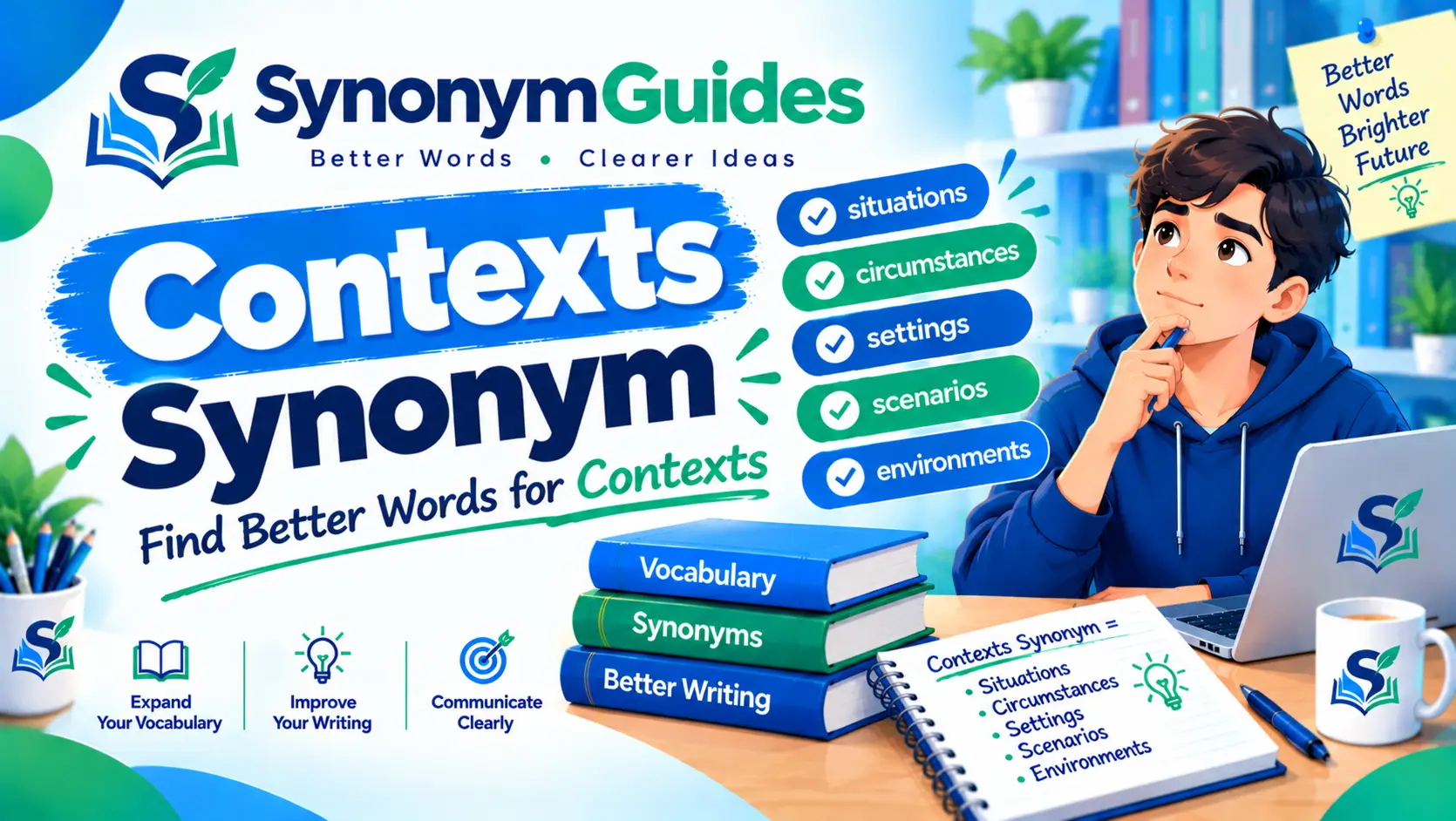
A synonym for contexts is circumstances, situations, settings, conditions, or backgrounds. These words describe the details surrounding an event, statement, or idea. However, the best alternative depends on what you mean. For example, settings often refers to a place or environment, while circumstances describes the conditions surrounding an event.
Key Takeaways
- Circumstances describes the conditions surrounding an event or situation.
- Situations refers to the conditions someone faces at a particular time.
- Settings describes the place or environment where something happens.
- Backgrounds refers to the facts or history that help explain something.
- Frameworks describes the structure or system used to understand an idea.
- Choosing the right synonym depends on whether you discuss language, events, people, or ideas.
What Is Another Word for Contexts?
Another word for contexts is circumstances. Other useful alternatives include situations, settings, backgrounds, conditions, and environments. Each word describes information that helps explain an event, statement, or idea.
For example, the context of a conversation includes the people involved, the topic, and the reason for speaking. In this case, background information may express the meaning more clearly.
Similarly, the contexts of historical events include the social, political, and economic conditions surrounding them. Here, circumstances or historical background may be better choices.
However, contexts can also refer to the words surrounding a particular word or phrase. In language studies, surrounding text or linguistic environment may be more accurate. Therefore, consider the meaning of your sentence before replacing the original word.
Best Synonyms for Contexts and Their Meanings
The following synonyms cover common situations in everyday speech, academic writing, and professional communication.
| Synonym | Meaning | Example |
| Circumstances | Conditions surrounding an event | The circumstances changed after the meeting. |
| Situations | Conditions at a particular time | Different situations require different responses. |
| Settings | Places or environments where things happen | The story explores several historical settings. |
| Backgrounds | Information that explains an event or idea | The teacher explained the backgrounds of both authors. |
| Conditions | Factors that affect an event or action | Working conditions improved over time. |
| Environments | Surroundings where people or things exist | Children learn in different environments. |
| Surroundings | Things or conditions around someone or something | Her surroundings influenced her decision. |
| Frameworks | Structures used to organize or understand ideas | Researchers used different frameworks to study the issue. |
| Perspectives | Particular ways of viewing something | The discussion included several cultural perspectives. |
| Situational factors | Details that influence a specific situation | Situational factors affected the final decision. |
| Settings of use | Situations in which something is used | The guide explains the settings of use for each expression. |
| Conditions of use | Rules or circumstances affecting how something is used | The conditions of use vary by industry. |
Some synonyms work better than others because contexts has several meanings. For example, settings works well when discussing places, while perspectives focuses on viewpoints. Likewise, backgrounds emphasizes information that helps explain a subject.
Deep and Powerful Words for Contexts
In academic and professional writing, more specific words can make your meaning clearer. However, these alternatives are not always direct replacements for contexts.
1. Circumstances: The facts and conditions surrounding an event. For example, the circumstances of the decision remain unclear.
2. Frameworks: Systems that organize information or guide thinking. For example, the researchers compared two theoretical frameworks.
3. Environments: The surroundings in which an activity takes place. For example, supportive environments can encourage learning.
4. Conditions: Factors that affect an outcome. For example, economic conditions influenced consumer spending.
5. Perspectives: Ways of understanding or viewing an issue. For example, the report considered different cultural perspectives.
6. Situational factors: Specific details that influence an event. For example, situational factors shaped the team’s response.
7. Historical background: Past events and facts that help explain the present. For example, historical background clarified the conflict.
8. Social setting: The social environment surrounding an interaction. For example, the social setting influenced their conversation.
9. Linguistic environment: The words or language features surrounding a particular expression. For example, the linguistic environment helped reveal the word’s meaning.
10. Conceptual framework: A set of ideas used to understand a topic. For example, the study developed a conceptual framework for analyzing behavior.
Common and Everyday Synonyms for Contexts
In everyday English, simple alternatives are often easier to understand. The best choice depends on the sentence and the information you want to emphasize.
- Situations: Use this word when describing what is happening. Example: We respond differently in different situations.
- Circumstances: Use it when explaining the conditions around an event. Example: Under these circumstances, we should wait.
- Settings: Choose this word for places or environments. Example: The app works in different settings.
- Background information: Use it for facts that explain a subject. Example: I need more background information before deciding.
- Conditions: Choose this word for factors affecting an outcome. Example: The plants grow well in warm conditions.
- Surroundings: Use it to describe nearby things or places. Example: The quiet surroundings helped her focus.
- Environment: Choose this word for the setting in which something happens. Example: A calm environment supports learning.
- Point of view: Use it when discussing someone’s way of seeing an issue. Example: From his point of view, the decision was fair.
Although these words overlap, they do not mean exactly the same thing. For example, a situation describes what is happening, while circumstances explain the conditions surrounding it.
Formal and Professional Synonyms for Contexts
Professional writing often requires precise language. Instead of repeating contexts, select a term that matches the subject.
- Circumstances: Suitable for reports about events, decisions, or outcomes.
- Conditions: Useful in business, science, and legal discussions.
- Frameworks: Appropriate for models, systems, and research methods.
- Environments: Common in workplace, technology, and educational writing.
- Parameters: Refers to limits or defined factors within which something operates.
- Situational factors: Useful when several details affect an outcome.
- Operating conditions: Describes the circumstances under which a system or process works.
- Historical background: Helps explain the origins of a policy, event, or decision.
For example, a business report might discuss market conditions rather than market contexts. Similarly, a research paper may refer to theoretical frameworks when explaining the ideas behind a study.
However, avoid choosing formal words simply to sound professional. Clear language is usually more effective than complicated wording.
Contexts Synonyms in Language and Writing
When discussing words, phrases, sentences, or communication, the meaning of contexts becomes more specific. It often refers to the language or information surrounding an expression.
Useful alternatives include:
- Surrounding text: The words placed before or after an expression.
- Linguistic environment: The language features surrounding a word.
- Sentence setting: The sentence in which a word appears.
- Textual surroundings: The nearby text that helps explain meaning.
- Usage situations: The situations in which a word or phrase is used.
- Communication settings: The conditions in which people communicate.
- Conversation background: Information that helps explain a discussion.
- Language environment: The linguistic conditions surrounding communication.
For example, the word bright can describe strong light or a clever person. The surrounding words help readers understand which meaning applies.
Similarly, the phrase break the ice usually refers to making people feel comfortable, not literally breaking frozen water. The conversational context helps explain the intended meaning.
Contexts Synonyms in Sentences
Here are examples showing how different alternatives work naturally in sentences.
- The circumstances surrounding the event remain unclear.
- Different situations call for different solutions.
- The novel uses several historical settings.
- Her educational background helped her understand the topic.
- Weather conditions affected the journey.
- A peaceful environment can improve concentration.
- The report examined the social surroundings of the community.
- Researchers used several theoretical frameworks.
- The meeting considered different cultural perspectives.
- Situational factors influenced the final outcome.
- The historical background explains why the policy changed.
- The surrounding text helped readers understand the unfamiliar word.
Notice that each alternative emphasizes a different detail. Therefore, choose the word that best communicates your intended meaning rather than replacing contexts automatically.
Contexts vs. Its Closest Synonyms
The table below compares some of the closest alternatives.
| Word | Main Meaning | Best Used For | Tone |
| Contexts | Information surrounding something | Language, ideas, events | General |
| Circumstances | Conditions surrounding an event | Decisions and events | Neutral |
| Situations | Conditions at a particular time | Everyday experiences | Conversational |
| Settings | Places or environments | Stories, events, activities | Neutral |
| Backgrounds | Facts or history explaining something | Research and personal history | Informative |
| Conditions | Factors affecting an outcome | Science, business, and daily life | Precise |
| Frameworks | Structures for organizing ideas | Research and planning | Academic |
| Perspectives | Ways of viewing an issue | Opinions and analysis | Analytical |
The main difference is that contexts is a broad word. It can include circumstances, background information, language, and social conditions.
By comparison, circumstances focuses on surrounding conditions, while backgrounds emphasizes information from the past. Meanwhile, frameworks refers to structures for understanding ideas, and perspectives focuses on viewpoints.
Different Ways to Say “Contexts”
You can replace contexts with different words or phrases depending on your audience and purpose.
Casual Alternatives
- Situations
- Circumstances
- Settings
- Surroundings
- Background information
Example: “We need to understand the circumstances before making a decision.”
Formal Alternatives
- Relevant circumstances
- Historical background
- Operating conditions
- Situational factors
- Theoretical frameworks
Example: “The report examines the relevant circumstances surrounding the decision.”
Academic Alternatives
- Linguistic environments
- Conceptual frameworks
- Historical conditions
- Social settings
- Cultural perspectives
Example: “The study explores how social settings influence language use.”
Alternatives for Clearer Writing
- The situation surrounding the event
- The information behind the statement
- The conditions in which something happens
- The words surrounding an expression
- The background needed to understand an idea
These phrases can be more helpful than a single synonym. In particular, they explain exactly which part of the context matters.
Related Words for Contexts
Several words are closely connected to contexts, although their meanings differ.
| Related Word | Meaning | Example |
| Context | The information surrounding something | Context helps explain the statement. |
| Contextual | Related to the situation or setting | Contextual clues revealed the meaning. |
| Contextually | In relation to a particular situation | The word was used contextually. |
| Contextualize | To explain something using relevant background | The teacher contextualized the historical event. |
| Contextualization | The act of placing something within its background | Contextualization improved the explanation. |
| Circumstantial | Related to surrounding facts or conditions | Circumstantial details supported the account. |
| Background | Information that explains a subject | The introduction provides useful background. |
| Setting | The place or situation in which something occurs | The setting shaped the story. |
| Environment | The surroundings affecting an activity | The environment influenced the results. |
| Framework | A structure for organizing ideas | The framework guided the research. |
These related words are useful when discussing communication, education, research, and analysis. However, grammatical form matters: contextualize is a verb, while contextual is an adjective.
Antonyms of Contexts
There is no single exact antonym for contexts because the word has several meanings. However, certain words express the absence of context or information.
- Isolation: Something considered separately from its surroundings.
- Detachment: Separation from a larger situation or connection.
- Disconnection: A lack of links between ideas or events.
- Fragmentation: The state of being divided into separate parts.
- Ambiguity: A lack of clear meaning, which context may help resolve.
- Irrelevance: A lack of connection to the subject being discussed.
- Decontextualization: Removing something from its original context.
- Incompleteness: The state of lacking necessary information.
For example, a quotation presented in isolation may be harder to understand than one shown with its original context. Likewise, decontextualization describes removing information from the circumstances that give it meaning.
These are related opposites rather than interchangeable antonyms. The best choice depends on whether you mean separation, missing information, or unclear meaning.
Frequently Asked Questions
What is the strongest synonym for contexts?
There is no single strongest synonym for contexts. However, circumstances is a useful choice when discussing events and decisions. For language studies, linguistic environment may be more precise. Meanwhile, frameworks works when discussing systems of ideas or methods of analysis.
What is a better word for contexts?
A better word depends on your sentence. Use circumstances for the conditions surrounding an event, settings for places or environments, and background information for facts that explain a subject. In academic writing, frameworks or perspectives may be more accurate when discussing theories and viewpoints.
What is a formal synonym for contexts?
Formal alternatives include circumstances, conditions, situational factors, operating conditions, and theoretical frameworks. For example, a research paper might discuss the social conditions surrounding a historical event. Choose the term that describes the relevant information rather than using a formal word without a clear reason.
What is another way to say contexts in writing?
In writing, you can use phrases such as surrounding information, background details, historical circumstances, or surrounding text. For example, when explaining a word’s meaning, surrounding text may be more precise than contexts. The best alternative depends on whether you are discussing language, events, or ideas.
Are context and contexts the same?
Context is singular, while contexts is plural. Use context when discussing one situation or set of surrounding details. In contrast, use contexts when referring to several situations, settings, or groups of background information. For example, a word may have different meanings in different contexts.
What is the difference between context and circumstances?
Context is a broad term for information that helps explain something. It may include language, history, culture, and surrounding events. Circumstances focuses more directly on the conditions surrounding a particular event or situation. Therefore, circumstances can form part of a context, but the two words are not always interchangeable.
What is the opposite of contexts?
There is no exact opposite of contexts. However, isolation, disconnection, and decontextualization can express the idea of separating something from its surroundings. For instance, presenting a sentence without its surrounding information can make its meaning less clear. Choose an opposite that fits the specific meaning you intend.
Final Thoughts
The best synonym for contexts depends on the subject you are discussing. Circumstances, situations, settings, backgrounds, and conditions are useful alternatives for everyday communication. For academic writing, frameworks, perspectives, and linguistic environments may offer greater precision.
Ultimately, focus on the meaning you want to communicate. Use circumstances for events, settings for environments, and surrounding text for language. By choosing words carefully, you can make your writing clearer, more natural, and easier to understand.

James Anderson is a language enthusiast and contributor at Synonym Guides. With a keen interest in linguistics and writing, he focuses on creating clear, well-researched content to help readers expand their vocabulary and improve their writing skills.