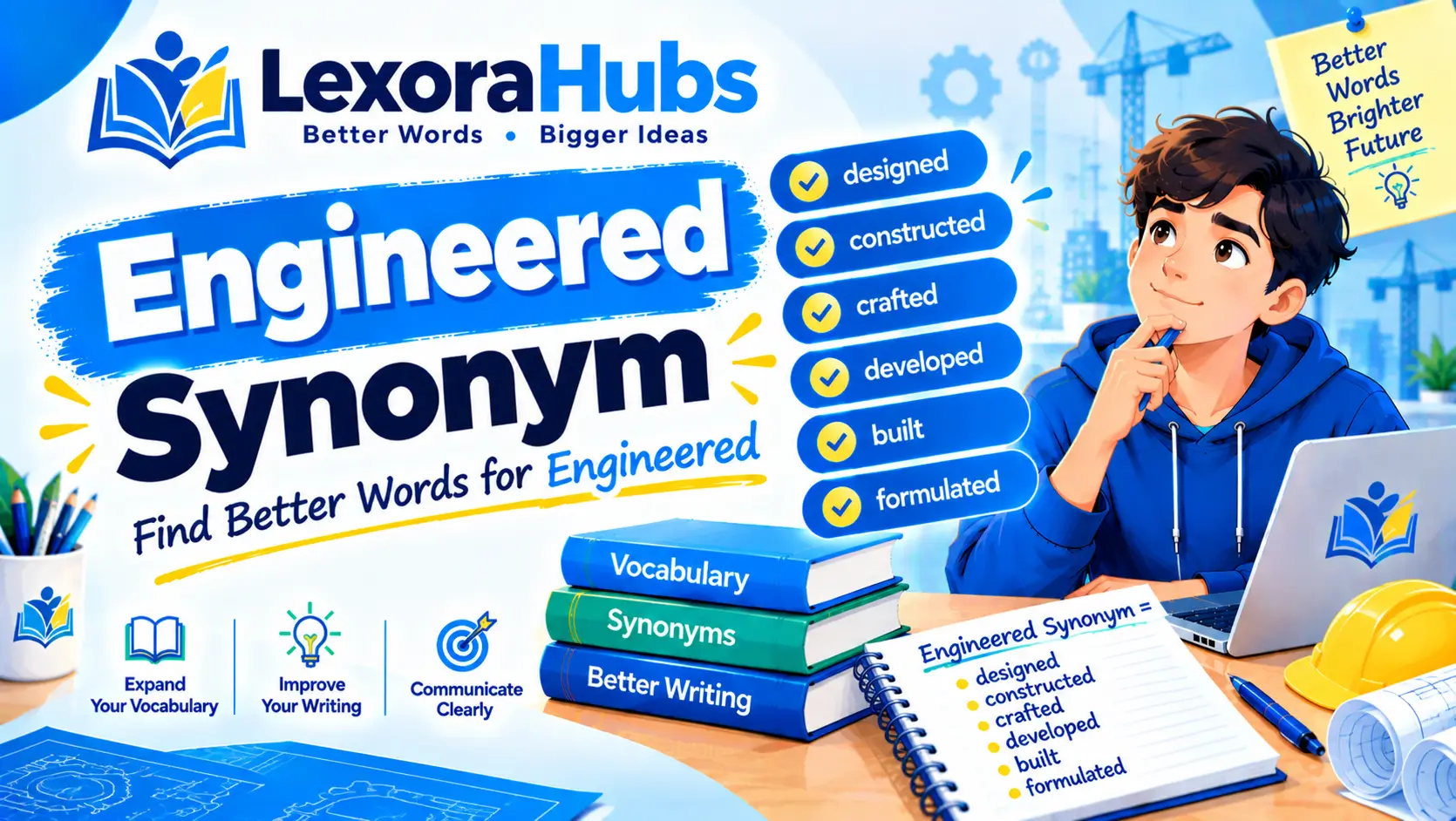
The best synonyms for engineered include designed, developed, created, constructed, built, devised, planned, produced, and fabricated. Each word describes something made or arranged, but the best choice depends on whether you are talking about a product, a system, a plan, or a result.
The word engineered usually means carefully designed, developed, or arranged to achieve a specific purpose. For example, “The company engineered a new system to improve productivity” means the company developed the system using deliberate planning and technical knowledge.
In this guide, you will learn the meaning of engineered, explore useful alternatives, compare closely related words, and discover how to use engineered synonyms in everyday English, professional writing, technical documents, and resumes.
What Does Engineered Mean?
Engineered is the past tense and past participle of the verb engineer. It means designed, developed, or built something through careful planning, technical knowledge, or a systematic process.
In simple English, when something is engineered, someone has deliberately created or arranged it to perform a particular function. This could involve designing a machine, developing software, building a bridge, or creating a solution to a complicated problem.
For example, “The engineers engineered a lightweight vehicle” means they designed and developed the vehicle to meet particular requirements, such as reducing weight and improving efficiency.
The word can also describe something carefully arranged to produce a specific outcome. For instance, “The team engineered a successful marketing campaign” suggests that the team planned the campaign strategically rather than leaving its success to chance.
Depending on the context, engineered can sound positive, neutral, or negative. It can suggest technical skill and careful planning, but phrases such as over-engineered may describe something unnecessarily complicated. The word can also describe a deliberately arranged outcome, which is not always viewed positively.
Quick List of Synonyms of Engineered
The following table provides useful alternatives to the word engineered and explains their basic meanings.
| Word | Simple Meaning |
| Designed | Planned how something should look or work |
| Developed | Created or improved something over time |
| Created | Brought something new into existence |
| Constructed | Built something by putting parts together |
| Built | Made or assembled something |
| Devised | Invented a plan, method, or solution |
| Planned | Decided how something should be done |
| Produced | Made or brought about a result |
| Fabricated | Manufactured something or invented a story |
| Formulated | Developed a plan, idea, or method systematically |
| Assembled | Put separate parts together |
| Implemented | Put a plan or system into action |
| Architected | Designed the structure of a complex system |
| Crafted | Made something with care and skill |
| Established | Set up or created something that can operate |
| Manufactured | Produced goods, usually using machinery |
| Arranged | Organized elements to achieve a purpose |
| Orchestrated | Coordinated several activities to achieve a result |
These words share some meaning with engineered, but they are not always exact replacements. For example, designed emphasizes planning, constructed emphasizes building, and devised emphasizes inventing a solution. Choosing the right alternative helps you communicate the intended meaning more accurately.
1. Designed
Designed means planned how something should look, function, or operate.
It is one of the closest synonyms for engineered because both words can describe creating something according to specific requirements. However, designed places greater emphasis on planning, structure, and intended features, while engineered often suggests technical development or practical implementation as well.
The word is commonly used in architecture, graphic design, software, product development, and business. It is especially suitable when discussing the appearance, layout, functionality, or intended purpose of something.
For example, an engineer might design a machine before building and testing it. In this situation, designed describes the planning stage, whereas engineered can describe the broader technical process.
Example
The team designed a website that works smoothly on mobile devices.
Use designed when you want to emphasize how something was planned or structured.
2. Developed
Developed means created, improved, or brought something to a more complete or advanced stage.
It is a strong alternative to engineered when discussing software, business strategies, products, systems, and new technologies. Both words can describe a process that transforms an idea into something useful.
The main difference is that developed often emphasizes progress over time. It can include research, testing, improvement, and implementation. Engineered more strongly suggests deliberate technical design or the arrangement of elements to achieve a particular result.
For example, a software company may develop an application through several stages of research and testing. If the company engineered a particular feature, the emphasis may be on the technical design that makes the feature work.
Example
The company developed a new platform to help small businesses manage their finances.
Use developed when you want to emphasize creating or improving something over time.
3. Created
Created means brought something new into existence.
It is a broad synonym for engineered because both words can describe making something that did not previously exist. However, created does not necessarily suggest technical expertise, detailed planning, or engineering methods.
This word works well in creative, professional, and everyday situations. People create artwork, businesses, opportunities, solutions, and digital products. By comparison, engineered is often more appropriate when a result involves systematic design or technical work.
For example, an entrepreneur might create a business idea, while a team engineers the software system that supports the business.
Example
The developers created a tool that helps users organize their daily tasks.
Use created when you want to emphasize bringing something new into existence.
4. Constructed
Constructed means built by putting different parts or materials together.
This word is closely related to engineered when discussing buildings, bridges, roads, machines, and physical structures. It emphasizes the process of assembling or building something according to a plan.
The difference is that constructed focuses primarily on building, while engineered can include calculations, technical decisions, testing, and the overall design process. Something can be engineered before it is constructed.
For example, engineers may calculate the strength of a bridge before construction begins. The bridge is then constructed according to the approved design.
Example
The workers constructed a strong bridge across the river.
Use constructed when you want to emphasize the physical building or assembly of something.
5. Built
Built means made, assembled, or developed into a usable form.
It is a simple and natural alternative to engineered, particularly in conversational English. The word can describe physical objects, digital products, businesses, relationships, and systems.
Unlike engineered, which often sounds technical, built is common in both informal and professional communication. It usually emphasizes the result or the process of making something functional.
For example, a developer might say they built a website using WordPress and Elementor. Saying they engineered the website could suggest a more technical or specialized development process.
Example
Our team built a reliable website for the new company.
Use built when you want a straightforward word for making or developing something.
6. Devised
Devised means invented or developed a plan, method, or solution through careful thought.
It is a useful synonym for engineered when describing strategies, procedures, systems, and ways to solve problems. Both words can suggest deliberate effort toward a specific goal.
However, devised focuses on the thinking and planning behind an idea. It does not necessarily mean that the idea was physically built or technically implemented.
For example, a manager may devise a strategy to increase sales, while the marketing team engineers a system to carry out that strategy.
Example
The researchers devised a new method for reducing energy consumption.
Use devised when you want to emphasize inventing a plan, method, or solution.
7. Planned
Planned means decided in advance what should happen and how it should be done.
It can replace engineered when the intended meaning relates to preparation, organization, or deliberate action. Both words may suggest that an outcome was not accidental.
The main difference is that planned focuses on preparation rather than technical execution. A plan can exist without being implemented, whereas engineered often implies that something was designed, developed, or arranged in practice.
For example, a company may plan a product launch before engineering the product’s technical features.
Example
The organizers planned the event carefully to avoid delays.
Use planned when you want to emphasize preparation and decisions made in advance.
8. Produced
Produced means made, generated, or brought about something.
It is a useful alternative to engineered when the focus is on an output, result, or finished product. It appears frequently in manufacturing, media, business, and scientific writing.
Unlike engineered, produced does not necessarily explain how something was designed or developed. It mainly communicates that something was made or that a particular result occurred.
For example, engineers may engineer an efficient machine, while a factory produces hundreds of copies of that machine.
Example
The new production process produced better results with less waste.
Use produced when you want to emphasize the finished product or outcome.
9. Fabricated
Fabricated has two important meanings: manufactured by assembling or processing materials, and invented or made up rather than based on truth.
In a technical or industrial context, it can be a synonym for engineered when discussing manufactured components, metal structures, or equipment. However, it is not always interchangeable with engineered because fabrication usually emphasizes making physical parts.
The word also has a negative meaning when it describes false information or invented evidence. For example, a fabricated story is one that someone made up.
Example
The workshop fabricated custom metal components for the machine.
Use fabricated when you mean manufacturing components or, in a different context, inventing something untrue.
10. Formulated
Formulated means developed or expressed a plan, idea, method, or mixture in a systematic way.
It is particularly useful in scientific research, business strategy, chemistry, medicine, and technical documentation. Like engineered, it can imply careful consideration and a deliberate process.
However, formulated emphasizes developing the content or structure of an idea, plan, or substance. It does not necessarily mean that the resulting system or product was built.
Example
The research team formulated a strategy to improve water quality.
Use formulated when you want to emphasize the systematic development of a plan, idea, or composition.
11. Assembled
Assembled means joined separate parts to make a complete object or system.
This word works well when the process involves putting components together. It is common in manufacturing, electronics, furniture production, and equipment installation.
The difference between assembled and engineered is important. Assembly can follow an existing design without requiring the person doing it to develop that design. Engineering may involve deciding how the components should function together in the first place.
Example
The technicians assembled the computer using high-quality components.
Use assembled when you want to emphasize joining separate parts into a complete product.
12. Implemented
Implemented means put a plan, decision, system, or idea into action.
It can be a useful alternative when engineered refers to developing or arranging a solution to address a particular need. However, implementation focuses on execution rather than the original design.
For example, a company may engineer a new workflow and then implement it across its departments. The first step concerns designing the solution; the second concerns putting it into practice.
Example
The company implemented a new system to improve customer service.
Use implemented when you want to emphasize putting a plan or solution into operation.
13. Architected
Architected means designed the overall structure of a complex system.
It is especially common in software development, cloud computing, enterprise technology, and systems engineering. It can be a close alternative to engineered when discussing how different technical components fit together.
However, architected usually emphasizes the system’s overall structure, organization, and relationships between components. Engineered can also include implementation, testing, optimization, and practical problem-solving.
Example
The developer architected a scalable platform for thousands of users.
Use architected when you want to emphasize the high-level structure of a complex technical system.
14. Crafted
Crafted means made or created with care, attention, and skill.
It is useful when engineered describes a carefully prepared message, strategy, product, experience, or solution. The word often has a positive tone because it suggests attention to detail and thoughtful execution.
However, crafted is less technical than engineered. It may sound more natural in creative writing, marketing, branding, and professional communication than in a formal engineering report.
Example
The team crafted a personalized solution for each customer.
Use crafted when you want to emphasize care, skill, and attention to detail.
15. Established
Established means created, set up, or made something recognized and operational.
It is useful when engineered refers to creating a process, organization, procedure, or system that needs to operate consistently.
The main difference is that established focuses on setting something up or making it an accepted part of an organization. It does not necessarily suggest technical design or engineering work.
Example
The organization established a reliable process for handling customer requests.
Use established when you want to emphasize setting up a lasting process, system, or organization.
16. Manufactured
Manufactured means produced goods, usually by using machinery, tools, or industrial processes.
It is a relevant synonym for engineered when discussing physical products and industrial production. However, the two words describe different stages or aspects of creating a product.
Engineering can involve designing and testing a product before production starts. Manufacturing focuses on producing the actual items. In addition, manufactured can describe something artificial or, in some contexts, an invented excuse or claim.
Example
The factory manufactured durable components for industrial equipment.
Use manufactured when you want to emphasize the production of physical goods.
Engineered vs. Designed
Engineered and designed are closely related, but they emphasize different aspects of creating something.
| Feature | Engineered | Designed |
| Main focus | Technical development and function | Planning, structure, and appearance |
| Typical use | Machines, systems, technical solutions | Websites, products, layouts, buildings |
| Meaning | Developed or arranged to achieve a purpose | Planned how something should look or work |
| Example | The team engineered a cooling system. | The team designed a cooling system. |
Both sentences are correct. The first emphasizes the technical development of the cooling system, while the second emphasizes the planning of its structure and functionality.
Practical tip: Use designed when the planning or layout matters most. Use engineered when technical development and how the solution works are central to your meaning.
Engineered vs. Developed
Engineered and developed can both describe creating something new, especially in technology and business.
However, developed often emphasizes the process of building or improving something over time. Engineered tends to emphasize deliberate technical decisions or the arrangement of components to meet specific requirements.
For example:
- Engineered: The team engineered a secure payment system.
- Developed: The team developed a payment application over six months.
The first sentence emphasizes the system’s technical design. The second highlights the creation process.
Practical tip: Choose developed for a broad description of progress or creation. Choose engineered when technical design or deliberate problem-solving is important.
Engineered vs. Created
Created is a general word for bringing something into existence, whereas engineered suggests a more deliberate or systematic approach.
For example:
- Engineered: The company engineered a system to reduce delivery times.
- Created: The company created a new delivery service.
The first example emphasizes the system developed to achieve a particular outcome. The second simply states that a new service was brought into existence.
Practical tip: Use created for a broad, simple statement. Use engineered when you want to communicate technical skill, careful planning, or a specific intended result.
Engineered vs. Constructed
Both words can describe creating physical structures, but they do not mean exactly the same thing.
Constructed emphasizes building or assembling something. Engineered emphasizes the technical design and development that make something function as intended.
For example:
- Engineered: Engineers engineered a bridge to withstand heavy loads.
- Constructed: Workers constructed the bridge over the river.
In many real projects, engineers engineer the structure and construction teams build it according to the design.
Practical tip: Use engineered when discussing technical design or performance. Use constructed when emphasizing the physical building process.
Engineered vs. Devised
Devised and engineered can both suggest deliberate planning, but their emphasis differs.
Devised generally describes inventing a method, plan, or solution. Engineered can describe both developing a solution and making the elements work together to achieve a particular outcome.
For example:
- Engineered: The company engineered a system to detect errors automatically.
- Devised: The company devised a strategy to reduce errors.
The engineered system is a practical technical solution, while the devised strategy is a plan.
Practical tip: Use devised for a plan or idea. Use engineered when describing a technically developed system or deliberately arranged result.
Positive Synonyms of Engineered
The word engineered is often neutral, but it can communicate skill, planning, and purposeful development. When you want a positive tone, the following alternatives may work well:
- Designed: Suggests thoughtful planning and an intentional structure.
- Developed: Highlights progress, improvement, and achievement.
- Crafted: Suggests care, skill, and attention to detail.
- Devised: Highlights creativity and problem-solving.
- Created: Communicates innovation and originality.
- Architected: Suggests expertise in designing complex systems.
- Optimized: Emphasizes improvements in performance or efficiency.
- Formulated: Suggests a systematic approach to developing an idea or method.
For example, “The team engineered an efficient solution” sounds professional and technical. “The team crafted an effective solution” places more emphasis on care and skill, while “The team optimized the system” highlights improved performance.
The best positive synonym depends on the quality you want to emphasize. If you want to highlight innovation, use created. If you want to communicate technical skill, engineered may be the stronger choice. If you want to highlight improved results, consider optimized.
Engineered Synonyms for Different Situations
The most appropriate synonym depends on what was engineered and why. A word that works in a technical report may not be the best choice in a school assignment, business proposal, or resume.
For Students
Students can use designed, developed, created, and devised when writing essays, describing projects, or explaining how they solved a problem.
For example:
The students designed a model that demonstrates how solar energy works.
If the project involved technical development, engineered may be more precise:
The students engineered a small solar-powered vehicle for their science project.
Choose a word that reflects what the students actually did rather than simply replacing one word with another.
For Athletes
In sports, engineered can describe deliberately producing a result, such as engineering a comeback or engineering a winning strategy. However, alternatives such as planned, orchestrated, developed, and executed may sound more natural depending on the situation.
For example:
The coach devised a strategy that helped the team win the final match.
Or:
The team engineered a remarkable comeback in the second half.
Use devised for the strategy and engineered when emphasizing how the team deliberately brought about the result.
For Business
In business, engineered often describes a process, solution, campaign, or strategy developed to achieve a goal. Useful alternatives include developed, designed, implemented, formulated, and orchestrated.
For example:
The company developed a new workflow to improve productivity.
If the emphasis is on putting the workflow into use, implemented may be more accurate:
The company implemented the new workflow across its departments.
Engineered synonyms for resume: When describing professional achievements, choose strong verbs that accurately explain your contribution. Examples include:
- Developed: Developed a workflow that reduced repetitive tasks.
- Designed: Designed responsive website layouts for desktop and mobile devices.
- Implemented: Implemented improvements to streamline daily operations.
- Created: Created a reporting system to organize business data.
- Optimized: Optimized website performance to improve loading speed.
- Architected: Architected a scalable software platform.
- Built: Built reusable website components for multiple projects.
Use engineered on a resume when you genuinely designed or developed a technical solution. For example, “Engineered an automated reporting workflow” is suitable if you were responsible for the technical design and implementation. Do not use it merely to make a basic task sound more impressive.
For Personal Challenges
When describing how someone deliberately achieved a difficult outcome, words such as orchestrated, planned, developed, and devised can be useful alternatives.
For example:
She devised a practical plan to balance her studies and part-time job.
You could also say:
He engineered a way to complete the project within a limited budget.
The first sentence emphasizes creating a plan. The second emphasizes finding a deliberate solution to a challenging situation.
Use devised for problem-solving and engineered when the outcome involved carefully arranging resources, steps, or circumstances.
For Formal Writing
Formal writing often benefits from precise verbs rather than repeatedly using engineered.
Consider these alternatives:
- Developed for systems, methods, and ideas.
- Designed for structures, plans, and processes.
- Formulated for theories, policies, and strategies.
- Constructed for physical structures and logical arguments.
- Implemented for putting decisions or plans into practice.
- Established for setting up procedures or organizations.
For example:
The researchers formulated a method for evaluating the results.
This sentence is more precise than saying the researchers engineered a method if the main work involved developing the method rather than constructing a technical system.
In formal reports, select the verb that accurately represents the work performed.
Engineered Synonyms in Example Sentences
The following examples show how the major synonyms can be used naturally.
Engineered:
The engineers engineered a cooling system for the new machine.
Designed:
The team designed a user-friendly website for the business.
Developed:
The company developed software to automate routine tasks.
Created:
The students created a model of the solar system.
Constructed:
Workers constructed a pedestrian bridge near the school.
Built:
The developer built a website using WordPress and Elementor.
Devised:
The manager devised a plan to reduce operating costs.
Planned:
The team planned the project carefully before starting work.
Produced:
The new process produced more consistent results.
Fabricated:
The workshop fabricated custom parts for the equipment.
Formulated:
The researchers formulated a hypothesis for the experiment.
Assembled:
The technician assembled the computer from individual components.
Implemented:
The company implemented a new customer support system.
Architected:
The software engineer architected a scalable cloud platform.
Crafted:
The writer crafted a clear message for the campaign.
Established:
The organization established a procedure for reviewing applications.
Manufactured:
The factory manufactured thousands of components each month.
Orchestrated:
The director orchestrated a successful product launch.
Each example uses a word that matches its particular context. Although these alternatives share related meanings, they emphasize different actions and outcomes.
How to Choose the Right Synonym
Choosing the right synonym involves more than finding a word with a similar definition. You should consider the context, intended meaning, tone, formality, and situation.
First, use designed when you want to emphasize planning, layout, or intended functionality. This is especially appropriate for products, websites, buildings, and systems.
Next, choose developed when something was created or improved over time. It works well for software, business processes, products, and professional achievements.
For a new idea or invention, created is often the simplest and most natural choice. If the focus is on inventing a solution to a problem, devised may be more precise.
If something was physically built, use constructed or assembled, depending on whether the emphasis is on building a structure or joining components.
For a technical system, engineered may be the best option because it communicates deliberate design and technical development. If you are discussing putting an existing plan into operation, implemented is often more accurate.
Finally, for professional writing, check that the word accurately describes your role. A resume should communicate your actual contribution, not just use impressive-sounding vocabulary.
Common Mistakes With Engineered Synonyms
Several words related to engineered are often treated as interchangeable even though their meanings differ.
1. Treating Designed and Engineered as Identical
Both words can describe creating a product or system, but designed often focuses on planning, while engineered can include technical development and practical performance.
Incorrect assumption: Anything designed was necessarily engineered.
Better approach: Use designed for the planning process and engineered when the technical development is relevant.
2. Using Created for Every Situation
Created is a broad word, but it may not communicate enough detail in technical writing.
For example:
The engineer created a structural support system.
This sentence is understandable. However, if the work involved technical calculations and specialized design, the following may be more informative:
The engineer engineered a structural support system.
Choose the second version only when it accurately reflects the work.
3. Confusing Manufactured With Engineered
Manufacturing refers to producing goods, while engineering can involve designing and developing the product before production.
For example, a company may engineer a machine and then manufacture hundreds of units. The two activities are related, but they are not identical.
4. Using Fabricated Without Checking Its Meaning
Fabricated can refer to manufacturing physical components, but it can also mean inventing something false.
Compare these sentences:
- The workshop fabricated a metal frame.
- The witness fabricated a story.
The first describes manufacturing; the second suggests dishonesty. Consider the context before choosing this word.
5. Using Overly Technical Language
Words such as architected, formulated, and engineered can be useful in professional writing, but they may sound unnatural in simple conversation.
For example, “I engineered a plan for dinner” is grammatically possible but unnecessarily formal in most everyday situations. “I planned dinner” is more natural.
6. Assuming Engineered Always Means Improved
Engineering something does not automatically mean that the result is better. A system can be engineered poorly, and a design can be unnecessarily complicated.
For example:
The team engineered a complicated solution that was difficult to maintain.
In this case, engineered describes the process, not necessarily a positive outcome.
The key lesson is to check the complete sentence and context before replacing engineered with another word.
Is Engineered Always a Positive Word?
No. Engineered is generally neutral, but its tone depends on the context.
In a positive context, it can suggest skill, technical knowledge, careful planning, and effective problem-solving.
For example:
The engineers engineered an energy-efficient system that reduced electricity consumption.
Here, the word describes a deliberate technical achievement with a beneficial result.
However, engineered can also describe an undesirable or questionable outcome.
For example:
The company engineered an artificial shortage to increase prices.
In this sentence, the word suggests deliberate manipulation rather than a positive achievement.
The phrase over-engineered is another example. It describes something designed or developed with more complexity than necessary.
For example:
The team over-engineered a simple website, making it harder to maintain.
The distinction is that engineered describes deliberate development, while over-engineered suggests excessive complexity or unnecessary effort.
Why Is Engineered Important?
The idea behind engineered is important because many practical solutions depend on careful planning, technical knowledge, and deliberate decisions.
In learning, students can engineer experiments, models, and practical solutions to understand how things work. They learn to test ideas instead of relying only on assumptions.
At work, teams engineer systems and processes to address specific needs. For example, a company may develop an automated workflow to reduce repetitive tasks.
In personal goals, people can use structured planning to organize their time, manage resources, and solve problems. In some contexts, engineered describes a deliberately arranged approach to achieving a goal.
In communication, choosing an accurate synonym helps readers understand the intended meaning. Saying a system was designed, built, or implemented can communicate different aspects of the same project.
In everyday life, engineering principles appear in ordinary objects and systems, from household appliances to transport networks. Understanding the word helps explain how these things are deliberately developed to perform particular functions.
Ultimately, the importance of engineered lies in its emphasis on purposeful development. It helps describe the process of turning requirements or ideas into practical results.
Frequently Asked Questions
What is another word for engineering?
Another word for engineering depends on the context. Design, development, technical planning, construction, and problem-solving may describe related activities.
However, engineering is a broad technical discipline, so these words are not exact replacements in every sentence. For example, engineering a bridge involves technical design and calculations, while construction refers primarily to building it.
What does it mean when something is engineered?
When something is engineered, it has been deliberately designed, developed, or arranged to achieve a particular purpose.
For example, an engineered product may have been developed to improve safety, efficiency, reliability, or performance. The exact meaning depends on what was engineered and how the word is used.
What is another word for over-engineered?
Possible alternatives to over-engineered include overcomplicated, unnecessarily complex, excessively elaborate, and overdesigned.
These expressions suggest that something has more complexity, features, or technical detail than necessary.
For example:
The team created an overcomplicated solution for a simple problem.
The most natural choice depends on whether you want to emphasize unnecessary complexity, excessive design, or wasted effort.
What are 5 synonym words?
Five useful synonyms for engineered are:
- Designed — planned how something should look or work.
- Developed — created or improved something.
- Created — brought something into existence.
- Constructed — built something from different parts.
- Devised — invented a plan or solution.
These words share related meanings, but each emphasizes a different part of the creation or development process.
What are the closest synonyms of engineered?
The closest alternatives are usually designed, developed, constructed, and created. The best choice depends on the subject.
For a technical system, designed or developed may work well. For a physical structure, constructed may be more appropriate. For a general achievement, created may communicate the meaning more naturally.
Is designed the same as engineered?
Not exactly. Both words can describe creating a product or system, but designed emphasizes planning and structure, while engineered often suggests technical development and functionality.
A product may be designed before it is engineered and manufactured. However, the precise relationship depends on the project.
Is developed a synonym for engineered?
Yes, developed can be a synonym for engineered when describing the creation or improvement of products, systems, and solutions.
However, developed is broader and can describe progress over time without necessarily implying specialized engineering work.
What is the opposite of engineered?
There is no single exact antonym for engineered. Possible opposites or contrasting expressions include unplanned, accidental, improvised, and naturally occurring, depending on the intended meaning.
For example, an engineered outcome is deliberately arranged, while an accidental outcome happens without being deliberately planned.
What is a simple synonym for engineered?
Designed is often a simple and useful synonym for engineered. Other straightforward options include built, created, and developed.
For example, “The team engineered a new system” could become “The team developed a new system,” if the broader meaning remains accurate.
What is a strong synonym for engineered?
Developed, designed, devised, and architected can be strong alternatives in professional or technical writing.
Architected is particularly suitable for describing the overall structure of a complex software system. Devised works well for strategies and solutions, while developed is suitable for a broad range of professional achievements.
Which engineered synonym is best for formal writing?
The best choice depends on the work being described. Developed is useful for systems and products, formulated suits plans and methods, constructed describes building, and implemented describes putting a plan into practice.
Choose the most precise word rather than selecting a synonym solely because it sounds formal.
Can engineered be used for a person?
Yes, but the meaning depends on the sentence. The word can describe a person deliberately arranging an outcome, as in “She engineered her team’s success through careful planning.”
It can also refer to a person or organism that has been genetically engineered, in the appropriate scientific context. It does not normally mean simply that someone has engineering skills.
Is created a positive synonym for engineered?
Created is generally neutral and can have a positive tone when describing innovation, achievement, or originality.
For example, “The team created an effective solution” communicates a successful result. However, the word itself does not guarantee that the result is beneficial.
What does fully engineered mean?
Fully engineered generally means that something has undergone the relevant engineering and development work needed for its intended purpose or stage of completion.
The exact meaning depends on the context. In product development, it might indicate that a design has been fully developed. It does not automatically mean that the product has been manufactured, tested, or approved.
What is an engineered synonym in a crossword?
For a crossword clue involving engineered, possible answers include built, made, devised, designed, or contrived.
The correct answer depends on the number of letters and the clue’s context. For example, built may fit a clue about construction, while devised may fit a clue about creating a plan.
What is the difference between engineered and contrived?
Engineered often describes deliberate technical development or the arrangement of elements to achieve a result. Contrived usually suggests something artificially arranged and may imply that it feels unnatural or forced.
For example, an engineered solution may be practical and effective, while a contrived explanation may seem artificial or unconvincing.
Conclusion
The best synonyms for engineered include designed, developed, created, constructed, built, devised, formulated, implemented, and architected. Each word communicates a related idea, but the differences matter.
Designed emphasizes planning, developed highlights creation or improvement, constructed focuses on building, and devised emphasizes inventing a plan or solution. Engineered is especially useful when describing deliberate technical development or the systematic arrangement of something to achieve a specific purpose.
When choosing an alternative, consider the sentence, the intended meaning, and the level of technical detail required. The right word will make your writing clearer, more natural, and more precise while helping you build a stronger English vocabulary.

Sarah Williams is a content writer at Synonym Guides, passionate about helping readers find the perfect word for every context. She enjoys exploring the nuances of the English language and making vocabulary learning simple and accessible for everyone.