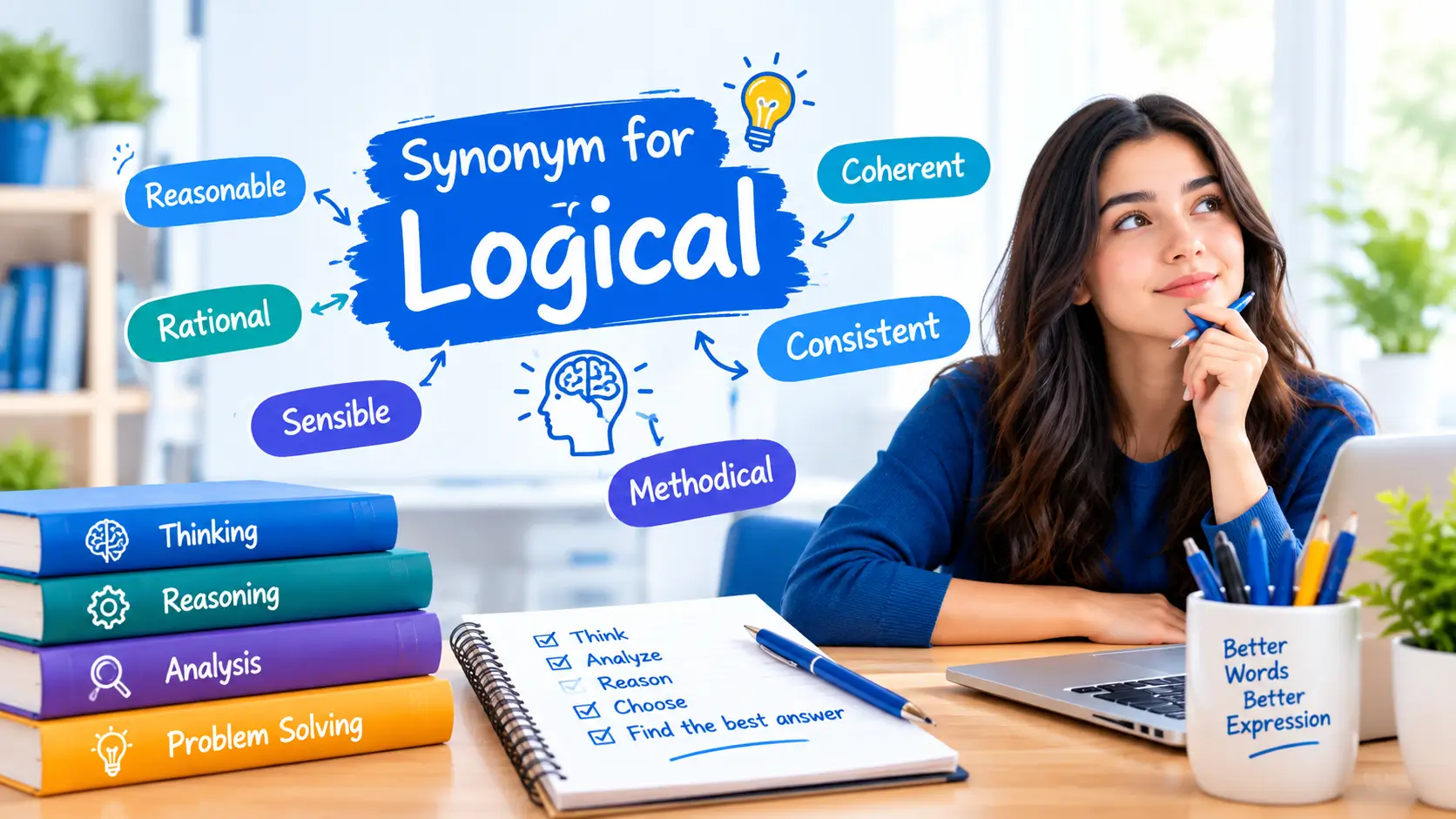
A synonym for logical is “rational.” Other common synonyms include reasonable, sound, coherent, sensible, and valid. These words all describe thinking or arguments that make sense and follow clear reasoning. They are useful for essays, speeches, and everyday writing when you want to avoid repeating “logical” too often.
Introduction
Picture this. You are writing an email to your boss. You explain your plan step by step. Your boss replies, “That makes perfect sense.” That is what a logical idea feels like. It flows. It fits together. Nothing feels out of place.
Here is a simple example. A teacher tells her class, “First we learn addition, then subtraction, then multiplication.” That order is logical. Each step builds on the last one.
Learning synonyms for logical helps in many ways. Students use these words to sound smart in essays. Bloggers use them to keep articles fresh and interesting. Content writers use them to avoid repeating the same word again and again. Daily English speakers use them to sound clear and confident in conversation.
“Logic will get you from A to B. Imagination will take you everywhere.” This quote reminds us that logic is the foundation, but words help us build on it.
Knowing many words for one idea makes your writing stronger. It also makes you sound more natural. “The true logic of this world is in the calculus of probabilities.” Even complex ideas can be explained with simple, clear words.
The Value of a Strong Vocabulary
Before we jump into the list, it helps to understand why this topic matters so much. A rich vocabulary is not about showing off. It is about being understood. When you know many ways to say “logical,” you can match your tone to your audience. A formal report might use “coherent” or “sound.” A casual chat might use “makes sense” or “reasonable.” “Words are, of course, the most powerful drug used by mankind.” Choosing the right word at the right time is a skill every writer can build.
Now let’s explore fifty strong alternatives to the word “logical,” each with a simple meaning and two easy examples.
1. Rational
Meaning: Rational means using clear thinking instead of guessing or feeling.
Examples:
- She made a rational choice about money.
- His rational answer solved the problem fast.
2. Reasonable
Meaning: Reasonable means fair and sensible based on the facts.
Examples:
- That is a reasonable price for lunch.
- Her reasonable request was approved right away.
3. Sound
Meaning: Sound means an idea is strong and well built.
Examples:
- His sound advice helped the whole team.
- The plan was sound from the start.
4. Coherent
Meaning: Coherent means the parts fit together and make sense.
Examples:
- Her coherent essay earned a top grade.
- He gave a coherent summary of events.
5. Consistent
Meaning: Consistent means staying the same and not changing randomly.
Examples:
- His consistent effort led to great results.
- The data showed consistent patterns each week.
6. Sensible
Meaning: Sensible means showing good judgment and practical thinking.
Examples:
- She wore sensible shoes for the hike.
- That was a sensible choice for dinner.
7. Valid
Meaning: Valid means an argument is correct and well supported.
Examples:
- His valid point changed my whole opinion.
- The valid argument convinced the entire jury.
8. Cogent
Meaning: Cogent means an argument is clear and very convincing.
Examples:
- Her cogent speech won the debate easily.
- He made a cogent case for change.
9. Analytical
Meaning: Analytical means breaking a problem into small clear parts.
Examples:
- His analytical mind solved the tricky puzzle.
- She took an analytical approach to budgeting.
10. Systematic
Meaning: Systematic means following an organized and step-by-step method.
Examples:
- He used a systematic way to study.
- Their systematic search found the missing file.
11. Methodical
Meaning: Methodical means careful, orderly, and following a clear plan.
Examples:
- She cleaned the house in a methodical way.
- His methodical notes made revision much easier.
12. Reasoned
Meaning: Reasoned means based on careful thought and clear steps.
Examples:
- His reasoned reply calmed the whole room.
- She gave a reasoned answer to critics.
13. Lucid
Meaning: Lucid means very clear and easy to understand quickly.
Examples:
- His lucid explanation made the topic simple.
- She wrote a lucid report on sales.
14. Clear-headed
Meaning: Clear-headed means thinking calmly without confusion or panic.
Examples:
- She stayed clear-headed during the emergency meeting.
- His clear-headed advice saved the whole project.
15. Sane
Meaning: Sane means showing calm, practical, and healthy thinking.
Examples:
- His sane approach kept the team calm.
- That was the only sane decision left.
16. Plausible
Meaning: Plausible means an idea seems believable and could be true.
Examples:
- His plausible excuse convinced the tired teacher.
- The plausible theory explained the strange results.
17. Credible
Meaning: Credible means trustworthy and believable based on evidence.
Examples:
- Her credible testimony helped win the case.
- The report used credible and trusted sources.
18. Judicious
Meaning: Judicious means showing wise and careful judgment in choices.
Examples:
- His judicious spending kept the business stable.
- She made a judicious choice under pressure.
19. Prudent
Meaning: Prudent means careful and wise about future decisions.
Examples:
- Saving money now is a prudent choice.
- His prudent planning avoided a huge mistake.
20. Wise
Meaning: Wise means showing good sense from experience and knowledge.
Examples:
- Her wise words guided the young team.
- That was a wise decision for everyone.
21. Sober
Meaning: Sober means serious, calm, and free from wild emotion.
Examples:
- He gave a sober look at the numbers.
- Their sober analysis avoided any wild claims.
22. Level-headed
Meaning: Level-headed means calm and sensible, even during stressful times.
Examples:
- She stayed level-headed during the loud argument.
- His level-headed plan solved the tough problem.
23. Orderly
Meaning: Orderly means arranged in a neat and clear pattern.
Examples:
- He kept an orderly desk at work.
- Their orderly process finished the project quickly.
24. Structured
Meaning: Structured means organized with a clear plan or shape.
Examples:
- The structured lesson helped students learn faster.
- Her structured approach made cooking much easier.
25. Organized
Meaning: Organized means arranged neatly so things are easy to find.
Examples:
- His organized files saved everyone valuable time.
- She kept an organized schedule every single week.
26. Deductive
Meaning: Deductive means reasoning from general facts to a conclusion.
Examples:
- His deductive skills solved the mystery quickly.
- She used deductive thinking during the quiz.
27. Inferential
Meaning: Inferential means drawing a conclusion from small clues given.
Examples:
- Her inferential guess turned out to be correct.
- The detective made an inferential leap forward.
28. Rigorous
Meaning: Rigorous means thorough, strict, and very carefully done.
Examples:
- The rigorous testing found every small error.
- His rigorous study proved the theory true.
29. Precise
Meaning: Precise means exact and very accurate in every detail.
Examples:
- Her precise measurements made the recipe perfect.
- He gave precise directions to the venue.
30. Exact
Meaning: Exact means completely correct without any small mistake.
Examples:
- She gave the exact time of arrival.
- His exact answer matched the textbook perfectly.
31. Sequential
Meaning: Sequential means following one step after another in order.
Examples:
- The sequential steps made assembly very simple.
- Her sequential plan avoided any confusing mix-up.
32. Stepwise
Meaning: Stepwise means done in small, clear, and separate stages.
Examples:
- The stepwise guide helped beginners learn coding.
- He followed a stepwise plan for training.
33. Straightforward
Meaning: Straightforward means simple, direct, and easy to follow along.
Examples:
- Her straightforward answer cleared up the confusion.
- The straightforward instructions took only five minutes.
34. Comprehensible
Meaning: Comprehensible means easy for people to understand right away.
Examples:
- His comprehensible summary helped every single student.
- The comprehensible chart explained the whole process.
35. Intelligible
Meaning: Intelligible means clear enough for anyone to easily understand.
Examples:
- Her intelligible speech reached the entire audience.
- The intelligible manual made setup very quick.
36. Well-reasoned
Meaning: Well-reasoned means an argument is thoughtful and clearly explained.
Examples:
- His well-reasoned essay impressed the strict teacher.
- She gave a well-reasoned answer during the interview.
37. Well-founded
Meaning: Well-founded means based on strong facts or good reasons.
Examples:
- Her well-founded concern led to a fix.
- The well-founded claim was backed by data.
38. Justified
Meaning: Justified means shown to be fair and reasonable action.
Examples:
- His justified anger came after repeated mistakes.
- The justified decision saved the whole company.
39. Legitimate
Meaning: Legitimate means fair, real, and accepted by clear standards.
Examples:
- She raised a legitimate concern about safety.
- His legitimate claim was proven in court.
40. Tenable
Meaning: Tenable means an idea can be defended and reasonably supported.
Examples:
- His tenable theory survived every tough question.
- The tenable plan satisfied the whole board.
41. Defensible
Meaning: Defensible means an idea can be reasonably explained and supported.
Examples:
- Her defensible choice held up under pressure.
- The defensible answer satisfied every strict critic.
42. Congruent
Meaning: Congruent means matching well and fitting together without conflict.
Examples:
- His actions were congruent with his words.
- The plan stayed congruent with company goals.
43. Harmonious
Meaning: Harmonious means fitting together smoothly without conflict or confusion.
Examples:
- Their harmonious teamwork finished the project early.
- The harmonious plan pleased every department involved.
44. Consequential
Meaning: Consequential means following naturally as a clear, expected result.
Examples:
- His consequential choice changed the entire outcome.
- The consequential error cost the team dearly.
45. Natural
Meaning: Natural means happening in a way that feels expected.
Examples:
- It felt like a natural next step.
- Her natural response matched the whole situation.
46. Predictable
Meaning: Predictable means expected and easy to guess ahead of time.
Examples:
- His predictable routine made planning very simple.
- The predictable outcome matched everyone’s early guess.
47. Practical
Meaning: Practical means useful, realistic, and based on real results.
Examples:
- Her practical advice helped the new intern.
- The practical solution saved a lot of time.
48. Pragmatic
Meaning: Pragmatic means focused on real results instead of theory.
Examples:
- His pragmatic plan fit the small budget.
- She took a pragmatic view of risk.
49. Discerning
Meaning: Discerning means noticing details and judging situations very carefully.
Examples:
- Her discerning eye spotted the small error.
- The discerning buyer compared every single option.
50. Perceptive
Meaning: Perceptive means quick to notice and understand small details.
Examples:
- His perceptive comment solved the hidden issue.
- Her perceptive question revealed the real problem.
Synonym for Logical Thinking
Logical thinking can also be called rational thinking, analytical thinking, or structured reasoning. These phrases describe the same skill: solving problems in clear, ordered steps. Students, workers, and writers all use this skill daily. A rational thinker breaks big problems into small, easy pieces. Practicing this style of thinking improves grades, work performance, and everyday decision making in surprisingly simple ways.
Synonym for Logical Person
A logical person can be called a rational person, a sensible person, or an analytical thinker. These people stay calm and make decisions based on facts, not feelings. They plan carefully and explain their choices clearly. Friends and coworkers often trust a logical person because their choices feel fair and predictable. This trait is especially valued in careers like science, law, and engineering.
Logical Antonyms
The opposite of logical includes words like illogical, irrational, unreasonable, and absurd. These words describe thinking that does not follow clear steps or facts. An illogical argument confuses people instead of convincing them. Knowing antonyms helps writers spot weak arguments in their own work. It also helps readers notice flawed reasoning in articles, speeches, or everyday conversations more quickly.
Logical Synonyms and Antonyms
Synonyms for logical include rational, sound, and coherent. Antonyms include illogical, irrational, and confused. Learning both sides builds a complete picture of the word. Writers use synonyms to add variety and antonyms to describe contrast or conflict. This balance makes essays, stories, and articles feel richer, more precise, and far more engaging for any reader who picks them up.
Logical Explanation Synonym
A logical explanation can also be called a rational explanation, a sound explanation, or a reasoned account. These phrases describe an answer that makes clear sense and follows the facts. Teachers, scientists, and detectives all rely on this kind of explanation. A strong, logical explanation removes doubt and builds trust because every step connects clearly to the next one.
FAQs About Synonyms for Logical
What is a word for logical?
A simple word for logical is “rational.” Other great options include reasonable, sound, coherent, and sensible. Each word fits slightly different situations. “Rational” works well for decisions and thinking, while “coherent” fits better for essays, speeches, or arguments that need to flow smoothly from one clear point to the next.
What is a synonym for the word logic?
Synonyms for logic include reasoning, rationale, and sense. “Reasoning” describes the process of thinking through a problem. “Rationale” describes the reason behind a decision. “Sense” is a simple, everyday word for the same idea. All three words point to clear, fact-based thinking rather than guessing or emotion.
What is another word for logical thinking?
Another word for logical thinking is rational thinking or analytical thinking. Both phrases describe solving problems using clear, ordered steps instead of guessing. Analytical thinking often focuses on breaking a problem into small parts, while rational thinking focuses more on making fair, sensible choices based on the available facts.
What words go with logic?
Words that pair naturally with logic include reasoning, evidence, argument, and conclusion. You might also hear “logic puzzle,” “logic gate,” or “flawed logic” in daily conversation. These pairings show how the word logic connects to problem solving, math, computer science, debate, and everyday clear thinking across many different fields.
Conclusion
Learning synonyms for logical makes your writing stronger and more interesting. Instead of repeating the same word, you can choose from rational, sound, coherent, sensible, and many more. This small habit improves essays, blog posts, emails, and everyday conversations. It also helps readers stay engaged instead of feeling bored by repeated words.
Try using a few of these words in your next email or school assignment. Notice how your writing feels more polished and confident. Over time, this practice becomes natural, and your vocabulary grows without much extra effort at all.