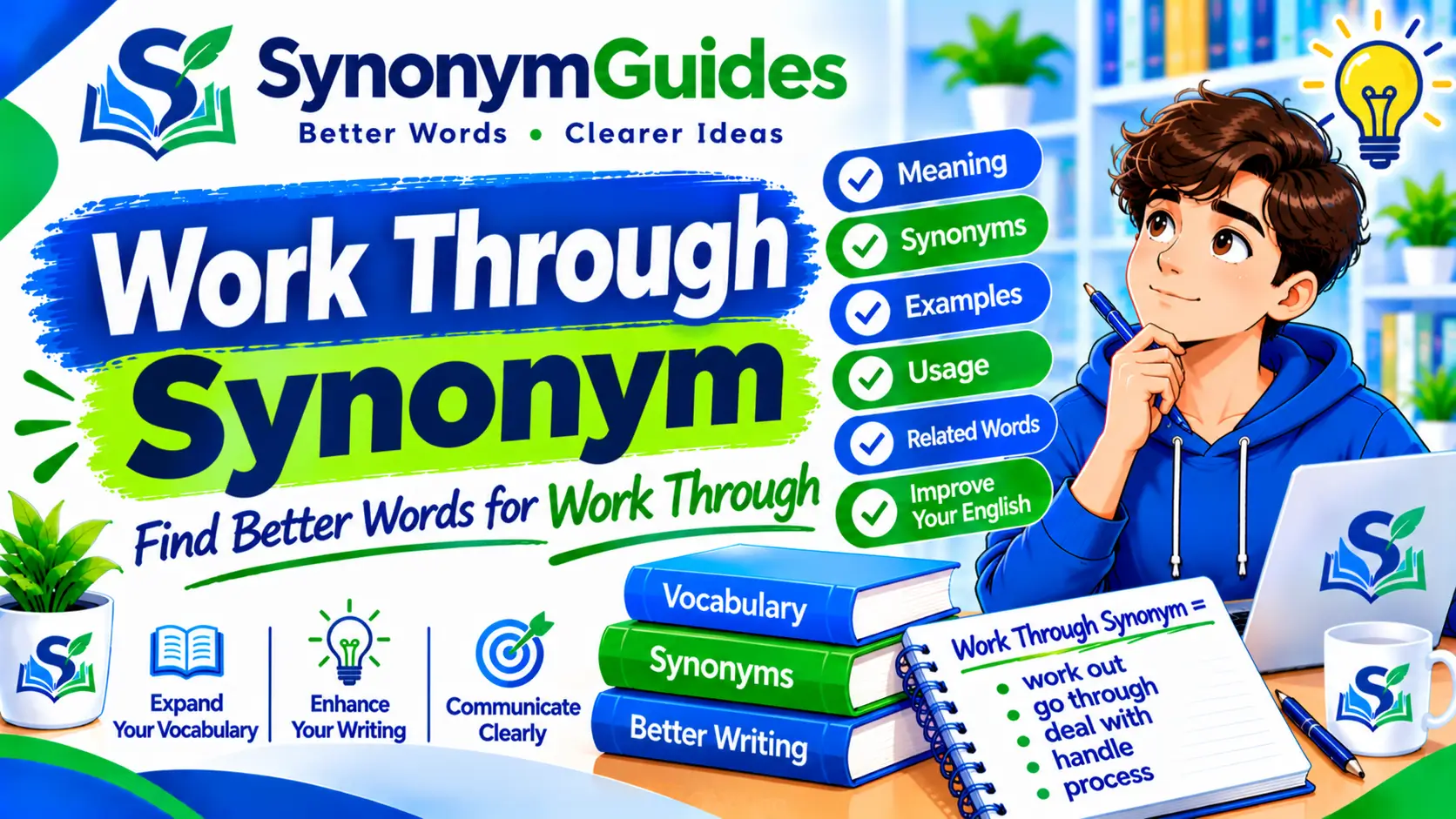
To work through means to deal with, examine, or gradually resolve a problem, difficulty, task, or complicated situation through effort and careful attention. The closest synonyms include deal with, tackle, address, resolve, overcome, and process. Other useful alternatives include handle, navigate, sort out, get through, examine, and work out. However, these expressions have different meanings, so the best choice depends on your context.
For example, you can resolve a problem when you find a solution, tackle a challenge when you begin dealing with it, or process emotions when you gradually understand and manage your feelings. This guide explains the closest synonyms, their differences, and how to use them naturally in everyday writing, academic work, and fiction.
Quick Answer: What Are the Synonyms of Work Through?
The closest synonyms of work through are deal with, tackle, address, resolve, overcome, and process. Depending on the situation, you can also use handle, navigate, sort out, get through, examine, and work out.
Some alternatives emphasize solving a problem, while others describe examining information, managing emotions, or completing a difficult experience. Therefore, these expressions are not interchangeable in every sentence.
List of Synonyms of Work Through
The best alternative to work through depends on whether you mean solving a problem, managing a difficult situation, or gradually understanding something. The following words and phrases highlight different aspects of the expression. As a result, you can quickly identify the word that best expresses your intended meaning.
| Synonym or alternative | Meaning | Best context | Example |
| Deal with | Take action to manage something | Problems and responsibilities | We need to deal with this issue today. |
| Tackle | Make an effort to address something difficult | Challenges and tasks | She decided to tackle the difficult assignment. |
| Address | Give attention to an issue | Professional and academic writing | The report addresses several concerns. |
| Resolve | Find a solution to a problem | Conflicts and disagreements | They resolved the misunderstanding. |
| Overcome | Successfully defeat a difficulty | Personal challenges | He overcame his fear of public speaking. |
| Process | Gradually understand or manage something | Emotions and experiences | She needed time to process the news. |
| Handle | Manage a situation or responsibility | Everyday and professional situations | I can handle the customer complaint. |
| Navigate | Find a way through a complicated situation | Complex circumstances | They navigated the challenges successfully. |
| Sort out | Organize or resolve something confusing | Everyday problems | We should sort out the scheduling issue. |
| Get through | Successfully finish a difficult experience | Emotional or challenging situations | She got through a difficult period. |
| Examine | Study something carefully | Research and analysis | Researchers examined the available evidence. |
| Work out | Find an answer or solution | Problems and disagreements | We worked out a practical solution. |
Keep in mind: Deal with, tackle, address, and process are among the closest alternatives, depending on the intended meaning. Resolve specifically emphasizes finding a solution, while overcome describes successfully defeating an obstacle. Examine and navigate describe particular activities involved in working through something rather than replacing the expression in every situation.
What Does Work Through Mean?
The phrasal verb work through means to gradually deal with, examine, or resolve something by putting in time, effort, and attention. It often involves handling difficulties, understanding complicated information, or managing challenging emotions.
This expression commonly appears in everyday conversations, academic discussions, workplace communication, counseling, and personal development. People use it when describing a process that requires patience rather than an immediate solution.
For example:
- The students worked through several difficult mathematics problems before completing the assignment.
- She is trying to work through her feelings after the unexpected news.
- Our team needs to work through the remaining technical issues before launching the website.
Grammatically, work through is a phrasal verb rather than a noun or adjective. Its base form is work through, its past tense and past participle are worked through, and its present participle is working through. The noun work refers to an activity or effort, while workable is an adjective meaning practical or capable of being successful. These related forms have different grammatical functions and should not be confused.
The Best Synonyms of Work Through Explained
The following alternatives explain different meanings of work through, helping you select an expression that fits your sentence naturally.
1. Deal With
Meaning: To take action to manage, address, or respond to a situation.
Deal with is one of the closest everyday alternatives to work through. Both expressions describe handling a situation, but deal with does not necessarily suggest a gradual process or sustained effort. However, work through often emphasizes the steps involved in reaching an understanding or solution.
Best context: Everyday conversations, workplace communication, responsibilities, and personal problems.
Example: The manager needs to deal with the employee’s concerns before the meeting.
2. Tackle
Meaning: To make a determined effort to address a difficult task or problem.
Tackle emphasizes taking action and confronting a challenge directly. By contrast, work through can describe the entire process of gradually handling something rather than simply beginning to address it.
Best context: Difficult assignments, business challenges, academic tasks, and practical problems.
Example: The research team decided to tackle the most complicated part of the project first.
3. Address
Meaning: To give attention to a problem, question, or concern.
Address is a professional alternative when you want to emphasize recognizing and responding to an issue. However, addressing a problem does not always mean resolving it completely, whereas working through something often suggests continued effort.
Best context: Academic essays, business reports, professional emails, and formal discussions.
Example: The new policy addresses several concerns raised by employees.
4. Resolve
Meaning: To find a satisfactory solution to a problem or disagreement.
Resolve is more specific than work through because it focuses on achieving a solution. Therefore, it is appropriate when the situation has reached a successful conclusion rather than when someone is still examining or managing it.
Best context: Conflicts, technical issues, misunderstandings, and professional disagreements.
Example: The two departments worked together to resolve the scheduling conflict.
5. Overcome
Meaning: To successfully defeat or move beyond a difficulty or obstacle.
Overcome highlights success after facing a challenge. However, work through can describe the process even when the outcome remains uncertain, while overcome usually suggests that the difficulty has been conquered.
Best context: Personal development, emotional challenges, career difficulties, and inspirational writing.
Example: She overcame several financial difficulties while building her business.
6. Process
Meaning: To gradually understand, interpret, or manage information, emotions, or experiences.
Process is particularly useful when discussing feelings, unexpected events, or complicated information. Unlike work through, it does not necessarily imply taking practical action to solve an external problem. Consequently, it is especially appropriate for internal or emotional experiences.
Best context: Psychology, personal reflection, emotional experiences, and information management.
Example: He needed a few days to process the unexpected announcement.
7. Handle
Meaning: To manage or take responsibility for a situation, task, or difficulty.
Handle is a simple and direct alternative that emphasizes the ability to manage something. By contrast, work through often suggests a series of steps, while handle can refer to managing a situation without describing the process.
Best context: Workplace responsibilities, customer service, daily tasks, and practical challenges.
Example: Our support team can handle customer complaints professionally.
8. Navigate
Meaning: To find a way through a complicated situation or set of challenges.
Navigate suggests making careful decisions while dealing with uncertainty or complexity. However, work through places more emphasis on the effort involved in addressing individual difficulties, whereas navigate emphasizes finding a suitable direction.
Best context: Career decisions, complicated relationships, business challenges, and uncertain circumstances.
Example: New employees must navigate several changes during their first month.
9. Sort Out
Meaning: To organize, clarify, or find a solution to something confusing or problematic.
Sort out is an informal expression that often means putting things in order or resolving a misunderstanding. Therefore, it works well in everyday communication, although it may sound less formal than work through.
Best context: Conversations, scheduling problems, misunderstandings, and practical arrangements.
Example: We need to sort out the payment details before signing the agreement.
10. Get Through
Meaning: To successfully pass through or complete a difficult experience.
Get through emphasizes reaching the other side of a challenging situation. Unlike work through, which often focuses on dealing with individual aspects of a problem, get through highlights successfully enduring or completing the experience.
Best context: Difficult periods, emotional struggles, challenging assignments, and stressful experiences.
Example: With support from her family, she managed to get through a difficult year.
Extra note: Some expressions have specialized meanings. For example, process is particularly appropriate for emotions and information, while navigate often describes complex situations. Similarly, get through usually emphasizes completion or endurance rather than finding a specific solution.
Which Synonym of Work Through Should You Use?
Choose an alternative based on the action you want to communicate. Some words emphasize solving a problem, while others highlight effort, understanding, or successful completion.
| Your intended meaning | Best choice | Reason |
| Managing an everyday problem | Deal with | Direct and widely understood |
| Starting a difficult task | Tackle | Emphasizes determined action |
| Discussing a professional issue | Address | Sounds clear and formal |
| Finding a final solution | Resolve | Highlights successful problem-solving |
| Defeating a personal obstacle | Overcome | Emphasizes success and progress |
| Understanding difficult emotions | Process | Describes gradual emotional understanding |
| Managing responsibilities | Handle | Simple and practical |
| Facing complicated circumstances | Navigate | Highlights careful decision-making |
For general readers, deal with, tackle, and handle are straightforward choices. Academic writing benefits from address, examine, and resolve, depending on the sentence. Meanwhile, creative writing can use overcome, process, navigate, and get through to communicate emotional depth and personal experiences.
Choosing Words for Different Writing Situations
Literature and Essays
Use examine, address, and analyze when discussing complex ideas, arguments, or evidence in academic writing. These alternatives sound precise and explain exactly what the writer is doing.
Creative Writing
Choose process, overcome, and get through when describing a character’s emotional journey or personal struggles. These expressions help communicate development, uncertainty, and eventual progress.
Formal or Political/Professional Analysis
Address and resolve are useful when discussing policies, organizational concerns, and public issues. Similarly, navigate works well when describing complicated political, economic, or professional circumstances.
Future or General Scenarios
Use tackle when discussing upcoming challenges and deal with when referring to general responsibilities. However, resolve is more suitable when you are specifically referring to a future goal of finding a solution.
Work Through vs. Similar Words
Although several expressions have meanings similar to work through, each emphasizes a different action or outcome. Understanding these distinctions helps prevent awkward word choices.
Work Through vs. Deal With
Work through suggests gradually examining or resolving something through continued effort, while deal with simply means managing or responding to a situation. Therefore, deal with is broader and does not always communicate a step-by-step process.
Example: We need to work through the technical problems before launch, while the support manager will deal with customer complaints.
Work Through vs. Resolve
Work through describes the process of handling a difficulty, whereas resolve emphasizes finding a solution. However, someone can work through a problem without necessarily resolving it immediately.
Example: The team worked through several disagreements before resolving the main issue.
Work Through vs. Overcome
Work through focuses on the process of dealing with a challenge, while overcome highlights successfully defeating it. Consequently, overcome is more appropriate when emphasizing a positive result.
Example: She worked through her fears and eventually overcame her anxiety about public speaking.
Work Through vs. Process
Work through can describe dealing with practical, intellectual, or emotional difficulties, whereas process often refers to gradually understanding information or feelings. By contrast, process is not usually the best choice for describing the practical resolution of an external problem.
Example: He needed time to process the disappointing news before discussing his next steps.
Work Through vs. Work Out
Work through emphasizes gradually addressing a problem or situation, while work out can mean finding a solution, reaching an agreement, or calculating something. As a result, the two expressions overlap but are not always interchangeable.
Example: We worked through the disagreements and worked out an arrangement that suited everyone.
As a result, use work through when describing sustained effort, and choose work out when emphasizing a solution, agreement, or calculation.
Common Mistakes When Using Work Through Synonyms
Choosing a similar expression without understanding its meaning can make a sentence confusing. Here are five common mistakes and better alternatives.
1. Using Resolve When the Problem Is Still Being Examined
Resolve suggests that a solution has been found. Using it while a problem is still under investigation can create the wrong impression.
Better choice: Use work through, examine, or address when the situation is still being handled.
2. Confusing Tackle With Overcome
Tackle means to begin addressing a challenge, whereas overcome suggests successfully defeating it. These words describe different stages of dealing with a difficulty.
Better choice: Use tackle for an ongoing challenge and overcome for a difficulty that has been successfully defeated.
3. Using Process for Every Type of Problem
Process is particularly suitable for emotions, experiences, and information. However, it may sound unnatural when discussing practical responsibilities or technical repairs.
Better choice: Use handle, address, or resolve for practical problems.
4. Choosing Informal Expressions in Formal Writing
Phrases such as sort out and get through are natural in conversations but may sound too informal in certain academic or professional documents.
Better choice: Consider address, examine, or resolve when writing formal reports and academic essays.
5. Confusing the Verb With Its Related Grammatical Forms
Work through is a phrasal verb, while work is also a noun and workable is an adjective. These forms cannot automatically replace one another.
Correct: The team needs to work through the remaining issues.
Incorrect: The team needs to workable through the remaining issues.
Better choice: Use work through as the verb phrase, work as a noun, and workable as an adjective describing something practical or achievable.
Related Words and Antonyms
Related Words
The following words describe concepts associated with work through, but they are not direct synonyms in every context.
- Effort: Physical or mental energy used to achieve something.
- Persistence: Continuing an activity despite difficulties.
- Progress: Movement toward a goal or desired result.
- Problem-solving: The process of identifying and finding solutions to problems.
- Resolution: The act or result of settling a disagreement or difficulty.
- Perseverance: Continued effort despite obstacles or setbacks.
- Reflection: Careful thought about an experience, situation, or decision.
Antonyms of Work Through
The clearest opposite of work through, when it means actively addressing a problem, is avoid. Other contrasting expressions include:
- Ignore: Refuse to give attention to something.
- Neglect: Fail to provide necessary attention or care.
- Evade: Avoid dealing with a responsibility or difficult situation.
- Abandon: Stop making an effort to complete something.
These expressions are contextual opposites rather than exact grammatical substitutes for work through.
Example: Instead of working through their disagreement, the employees chose to avoid the discussion.
Frequently Asked Questions
1. What Is the Closest Synonym of Work Through?
Deal with is one of the closest general synonyms of work through because both describe managing a situation or difficulty. However, tackle, address, and resolve may be more accurate when the sentence emphasizes action, attention, or finding a solution.
2. What Is Another Word for Working Through?
Another word for working through is dealing with, handling, or tackling, depending on the context. For emotional experiences, processing is often a more natural alternative.
3. Is Deal With the Same as Work Through?
Deal with and work through have similar meanings, but they are not identical. Deal with broadly describes managing something, while work through often emphasizes gradual effort and a process of understanding or resolution.
4. Is Overcome a Synonym for Work Through?
Overcome is a contextual synonym because both expressions can describe dealing with difficulties. However, overcome specifically emphasizes successfully defeating an obstacle, while work through can describe the process without guaranteeing success.
5. What Is the Opposite of Work Through?
Avoid is a clear opposite when work through means actively dealing with a problem. Other contrasting expressions include ignore, neglect, evade, and abandon.
6. Can I Use Resolve Instead of Work Through?
Yes, you can use resolve when you specifically mean finding a solution to a problem or disagreement. However, resolve is not suitable when you only mean examining an issue, processing emotions, or gradually handling a difficult experience.
7. What Is the Difference Between Work and Workable?
Work is commonly used as a noun or verb referring to an activity, effort, or task. Workable is an adjective meaning practical or capable of being successfully implemented, so it cannot replace the phrasal verb work through.
Conclusion
The best synonyms of work through include deal with, tackle, address, resolve, overcome, and process. Other useful alternatives are handle, navigate, sort out, get through, examine, and work out. Each expression communicates a slightly different aspect of managing a challenge, understanding a situation, or finding a solution.
For academic and professional writing, address, examine, and resolve provide clarity and precision. In creative writing, process, overcome, and get through can communicate emotional experiences and personal struggles more naturally. Always consider your intended meaning, choose words that fit the context, and focus on writing clearly and precisely.

James Anderson is a language enthusiast and contributor at Synonym Guides. With a keen interest in linguistics and writing, he focuses on creating clear, well-researched content to help readers expand their vocabulary and improve their writing skills.