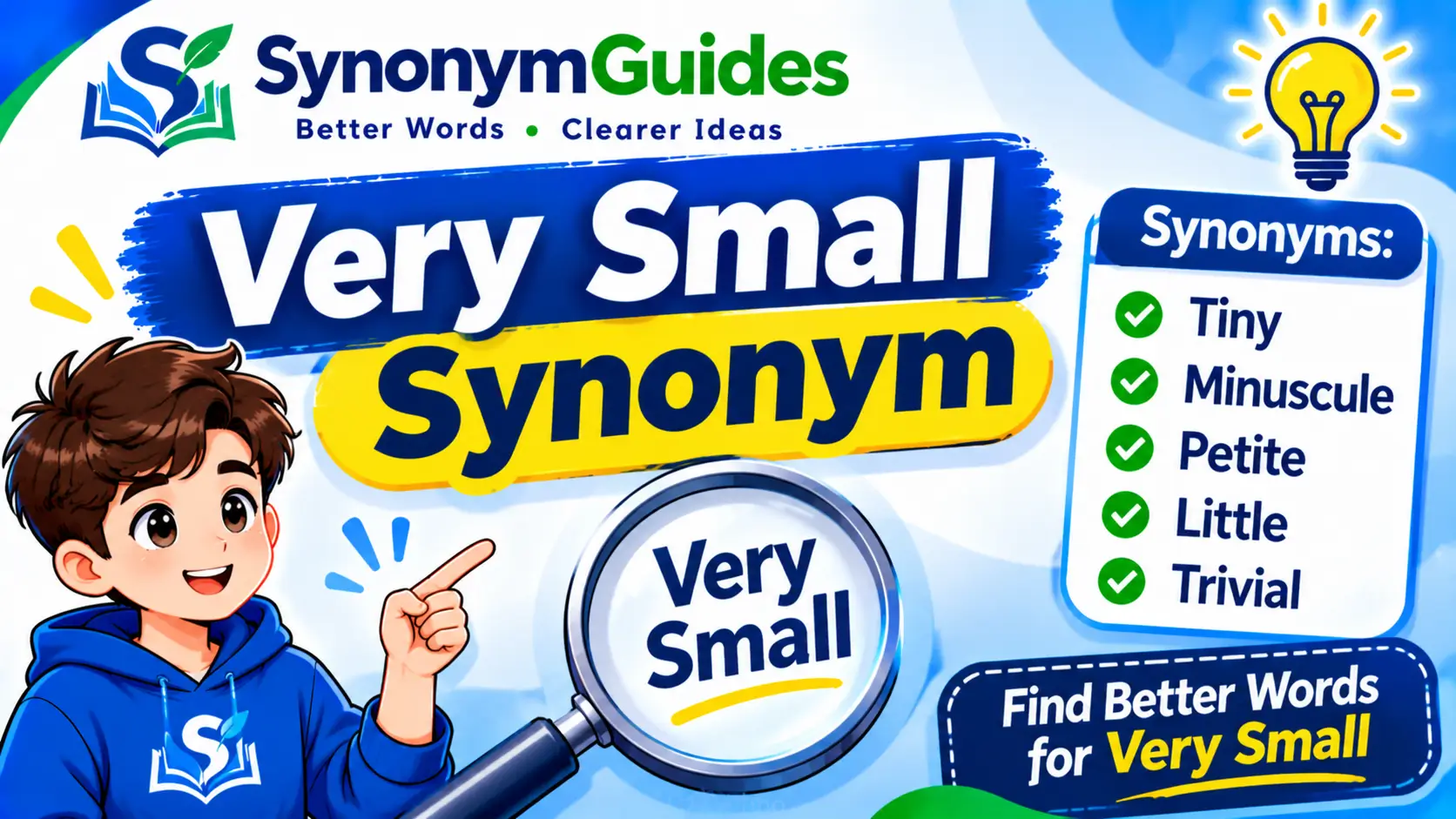
Tiny, miniature, minuscule, little, petite, microscopic, diminutive, and compact are useful synonyms for very small. However, these words do not always mean exactly the same thing. Some describe physical size, while others emphasize an extremely small amount, delicate appearance, or limited dimensions.
This guide explains the most useful alternatives to very small, their meanings, differences, and examples. As a result, you can choose the right word for your sentence and tone.
What Does Very Small Mean?
The phrase very small describes something that has a size, amount, quantity, or dimension much smaller than usual or expected. It emphasizes that something is noticeably little or limited in size.
Example: The kitten was very small when we brought it home.
This phrase can describe physical objects, such as tiny houses, little toys, and miniature decorations. It can also describe amounts, spaces, details, and measurements. In everyday English, very small is a simple way to emphasize that something has limited dimensions.
Quick Answer: Synonyms of Very Small
Here are 10 useful alternatives to very small, along with their meanings and best uses.
| Synonym | Meaning | Best Used For |
| Tiny | Extremely small in size | Everyday descriptions |
| Minuscule | Extremely or remarkably small | Precise descriptions |
| Microscopic | Too small to see without magnification | Scientific contexts |
| Miniature | A smaller version of something | Models and objects |
| Petite | Small and delicately proportioned | People and clothing |
| Little | Small in size or amount | Everyday conversation |
| Diminutive | Unusually small in size | Formal descriptions |
| Compact | Small but efficiently arranged | Products and spaces |
| Minute | Extremely small in size or quantity | Formal writing |
| Lilliputian | Extremely tiny | Literary descriptions |
10 Detailed Synonyms of Very Small
1. Tiny
Tiny means extremely small in physical size, amount, or appearance. It is one of the closest alternatives to very small and works naturally in everyday conversations and informal writing.
Example:
- A tiny bird built its nest outside our bedroom window.
- She found a tiny button underneath the sofa.
Tone and Usage: Everyday, friendly, and widely understood.
Very small vs. Tiny: Very small is a general phrase, while tiny is a more direct and expressive adjective.
2. Minuscule
Minuscule describes something exceptionally small, often smaller than people would normally expect. It is particularly useful when emphasizing tiny details, measurements, or quantities.
Example:
- The document contained a minuscule printing error.
- Only a minuscule amount of sugar was added to the recipe.
Tone and Usage: Formal and descriptive, especially in academic and professional writing.
Very small vs. Minuscule: Minuscule emphasizes an exceptionally small size or amount.
3. Microscopic
Microscopic refers to something so small that it cannot normally be seen clearly without a microscope. It is commonly used in science, medicine, and technical discussions.
Example:
- The scientist discovered microscopic organisms in the water.
- A microscopic crack appeared on the glass surface.
Tone and Usage: Scientific, technical, and precise.
Very small vs. Microscopic: Very small describes general size, whereas microscopic suggests a size that requires magnification to observe clearly.
4. Miniature
Miniature describes something made in a much smaller version of its normal or original form. It is especially useful for models, replicas, decorations, and collections.
Example:
- He bought a miniature version of the famous castle.
- The artist created a miniature garden inside a glass container.
Tone and Usage: Descriptive, artistic, and commonly used in everyday English.
Very small vs. Miniature: Very small describes size generally, while miniature often suggests a reduced version of something larger.
5. Petite
Petite means small and delicately proportioned. It is commonly used to describe people, clothing sizes, furniture, and objects with an elegant or delicate appearance.
Example:
- She selected a petite dress for the formal dinner.
- The restaurant had a petite table near the window.
Tone and Usage: Polite, descriptive, and often associated with fashion.
Very small vs. Petite: Petite emphasizes small proportions and delicacy rather than simply limited size.
6. Little
Little means small in size, quantity, or degree. It is one of the easiest alternatives to very small and is frequently used in ordinary conversations.
Example:
- A little puppy followed us down the street.
- There was a little space between the two chairs.
Tone and Usage: Informal, friendly, and suitable for everyday communication.
Very small vs. Little: Little is a general size description, while very small adds stronger emphasis.
7. Diminutive
Diminutive describes something unusually small or noticeably smaller than typical objects of the same kind. It can also suggest a delicate or compact appearance.
Example:
- The diminutive house stood beside a much larger building.
- A diminutive figure appeared in the distance.
Tone and Usage: Formal, literary, and descriptive.
Very small vs. Diminutive: Diminutive is a more sophisticated word that emphasizes unusually small proportions.
8. Compact
Compact describes something small and efficiently arranged without unnecessary space. It often refers to products, furniture, buildings, and equipment.
Example:
- The compact camera fits easily inside my backpack.
- They designed a compact apartment for modern city living.
Tone and Usage: Professional, practical, and commonly used in product descriptions.
Very small vs. Compact: Very small focuses on size, while compact suggests efficient use of limited space.
9. Minute
Minute, pronounced my-NOOT, means extremely small or insignificant in size or amount. It is often used in formal writing when discussing details, measurements, and quantities.
Example:
- The machine detected a minute change in temperature.
- A minute particle of dust covered the screen.
Tone and Usage: Formal, technical, and precise.
Very small vs. Minute: Minute emphasizes an exceptionally small measurement or detail.
10. Lilliputian
Lilliputian means extremely tiny or unusually small. The word comes from Lilliput, the fictional land of tiny people in Jonathan Swift’s Gulliver’s Travels.
Example:
- The artist created a Lilliputian village inside a wooden box.
- The garden contained Lilliputian furniture and miniature decorations.
Tone and Usage: Literary, imaginative, and less common in everyday conversation.
Very small vs. Lilliputian: Lilliputian gives a more imaginative and literary impression of extreme smallness.
Synonyms of Very Small in Different Contexts
The best alternative depends on what you are describing. A word suitable for a physical object might not work for a measurement or a person.
1. Very Small Physical Objects
When describing objects, toys, furniture, animals, or other physical things, choose words that clearly communicate their size.
Use:
- Tiny
- Miniature
- Little
- Diminutive
- Petite
Example: The shop displayed a very small wooden house.
Alternative rewrites:
- The shop displayed a tiny wooden house.
- The shop displayed a miniature wooden house.
2. Very Small Amounts or Measurements
When describing limited quantities, measurements, differences, or details, more precise alternatives can improve your writing.
Use:
- Minuscule
- Minute
- Negligible
- Microscopic
- Insignificant
Example: There was a very small difference between the two measurements.
Alternative rewrites:
- There was a minute difference between the two measurements.
- There was a negligible difference between the two measurements.
3. Very Small Spaces and Designs
For rooms, apartments, devices, and products, choose words that describe limited dimensions or efficient arrangements.
Use:
- Compact
- Petite
- Miniature
- Tiny
- Space-saving
Example: They purchased a very small desk for their home office.
Alternative rewrites:
- They purchased a compact desk for their home office.
- They purchased a space-saving desk for their home office.
Very Small vs. Tiny
Both words describe something with limited physical dimensions. However, tiny is usually more expressive and directly communicates extreme smallness.
Examples:
- The very small puppy needed special care.
- A tiny puppy slept inside the basket.
Use very small when you want a straightforward description. Choose tiny when you want a shorter and more natural alternative.
Very Small vs. Minuscule
Minuscule emphasizes an exceptionally small size or amount. Very small is more general and easier to understand in casual communication.
Examples:
- The very small error was difficult to notice.
- The minuscule error was barely visible under normal lighting.
Use minuscule in technical or formal descriptions where precision matters.
Very Small vs. Microscopic
Microscopic suggests something that requires magnification to observe clearly. Very small does not necessarily mean something is invisible to the naked eye.
Examples:
- The researcher examined a very small insect.
- The researcher examined microscopic bacteria.
Use microscopic when describing scientific objects, organisms, or extremely tiny structures.
Very Small vs. Miniature
Miniature generally describes a smaller representation or version of something larger. Very small simply describes its dimensions.
Examples:
- They lived in a very small house.
- The museum displayed a miniature model of the house.
Use miniature when describing replicas, models, or reduced versions of familiar objects.
Formal Synonyms for Very Small
In professional, academic, and technical writing, these alternatives can make descriptions more precise:
- Minuscule
- Minute
- Microscopic
- Diminutive
- Negligible
- Insignificant
- Compact
- Inconsequential
Not all these words are exact synonyms, so consider the context before replacing very small with a more formal alternative.
Simple Synonyms for Very Small
If you want easy words that readers can understand immediately, consider these everyday alternatives:
- Tiny
- Little
- Small
- Mini
- Miniature
- Petite
These words work well in casual conversations, school assignments, social media posts, and simple descriptions.
Positive Words Related to Very Small
Smallness is not always a disadvantage. Sometimes, a small object or space can be attractive, practical, convenient, or delicate.
Here are some positive words related to very small:
- Petite
- Compact
- Delicate
- Adorable
- Charming
- Miniature
- Elegant
- Cozy
Example: The petite apartment had a charming design and a cozy atmosphere.
Examples of Very Small in Sentences
Here are 10 natural examples using different alternatives to very small:
- A tiny butterfly landed on the colorful flower.
- The scientist discovered minuscule particles in the sample.
- Microscopic organisms can exist in freshwater environments.
- She collected miniature houses from different countries.
- The petite handbag matched her evening outfit perfectly.
- A little kitten was sleeping beside the fireplace.
- The diminutive statue attracted attention from visitors.
- We purchased a compact refrigerator for our small kitchen.
- The machine detected a minute change in pressure.
- The artist designed a Lilliputian village for the exhibition.
Common Mistakes With Very Small Synonyms
Choosing the wrong alternative can change the meaning of a sentence. Here are some common mistakes to avoid.
1. Using Microscopic for Every Small Object
Less precise: She bought a microscopic handbag.
Better: She bought a tiny handbag.
Microscopic usually describes things that require magnification to see clearly. Tiny is more appropriate for ordinary physical objects.
2. Confusing Miniature With Tiny
Less precise: They purchased a miniature amount of flour.
Better: They purchased a minuscule amount of flour.
Miniature generally refers to a smaller version of an object, not an unusually small quantity.
3. Using Petite for Every Object
Less precise: The petite bacteria were visible under the microscope.
Better: The microscopic bacteria were visible under the microscope.
Petite is generally associated with small, delicate proportions, while microscopic is more suitable for extremely tiny organisms.
4. Confusing Compact With Extremely Small
Less precise: The compact particle was invisible to the naked eye.
Better: The microscopic particle was invisible to the naked eye.
Compact suggests an efficiently arranged object, not necessarily something extremely small.
Related Words to Very Small
Several words are associated with small dimensions, limited quantities, and reduced proportions. Understanding these related terms can help expand your vocabulary.
- Small
- Narrow
- Short
- Shallow
- Limited
- Reduced
- Minimal
- Modest
- Slight
- Negligible
- Insignificant
- Delicate
- Subtle
- Undersized
- Space-saving
Some words describe physical dimensions, while others refer to amounts, importance, or degree. Therefore, always consider the sentence before choosing a replacement.
Antonyms of Very Small
There is no single perfect opposite for every use of very small. However, several words describe objects, quantities, and spaces that have considerably greater dimensions.
Common contrasting words include:
- Huge
- Enormous
- Massive
- Gigantic
- Large
- Immense
- Colossal
Example: Instead of a tiny apartment, they purchased an enormous house with several bedrooms.
FAQs About Synonyms of Very Small
1. What Is the Closest Synonym for Very Small?
Tiny is generally the closest synonym for very small. Both describe something that has extremely limited physical dimensions.
2. What Is Another Word for Very Small in Life?
Words such as little, tiny, miniature, and petite can describe small things in everyday life. The best choice depends on whether you are discussing people, objects, spaces, or quantities.
3. What Is a Positive Synonym for Very Small?
Petite, compact, delicate, and charming can communicate positive qualities associated with smallness. These words are particularly useful when describing attractive objects, clothing, or living spaces.
4. What Is a Poetic Synonym for Very Small?
Lilliputian is a distinctive literary alternative for extremely small. Other expressive choices include diminutive, tiny, and delicate.
5. Is Very Small the Same as Tiny?
They have almost the same general meaning, but tiny often communicates a stronger sense of smallness. Very small is a descriptive phrase, whereas tiny is a single adjective.
6. What Is the Opposite of Very Small?
Common opposites include huge, enormous, massive, gigantic, and immense. The most appropriate choice depends on the object or quantity being described.
Conclusion
Choosing the right synonym for very small can make your writing clearer, more natural, and more expressive. Words such as tiny, minuscule, microscopic, miniature, petite, and diminutive are useful alternatives, but each communicates a slightly different meaning.
For everyday conversations, tiny and little are excellent choices. For professional writing, consider minuscule, minute, or compact. Always think about context, tone, and exact meaning before selecting an alternative to very small.